Question
Find the values of $x$ for which $\left|\begin{array}{ll}3 & x \\ x & 1\end{array}\right|=\left|\begin{array}{ll}3 & 2 \\ 4 & 1\end{array}\right|$.

Answer

(d) : We have, $\left|\begin{array}{ll}3 & x \\ x & 1\end{array}\right|=\left|\begin{array}{ll}3 & 2 \\ 4 & 1\end{array}\right|$
$
\Rightarrow \quad 3-x^2=3-8 \quad \Rightarrow \quad x^2=8 \text {. Hence, } x= \pm 2 \sqrt{2}
$

Need a full question paper?

Generate a complete, print-ready paper with questions like this in minutes — across 16+ boards, with answer keys.
Start Generating Free

Similar questions

Two events A and B such that $P ( A )=\frac{1}{4}, P ( A \mid B )=\frac{1}{2}$, and $P(B \mid A)=\frac{2}{3}$, then value of $P(B)$ :
The number of commutative binary operation that can be defined on a set of 2 elements is:
  1. 8
  2. 6
  3. 4
  4. 2
It is given that $X\left[\begin{array}{cc}3 & 2 \\ 1 & -1\end{array}\right]=\left[\begin{array}{ll}4 & 1 \\ 2 & 3\end{array}\right]$. Then matrix $X$ is :
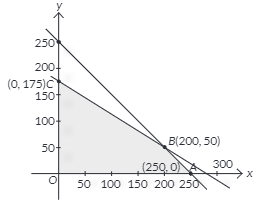
The corner points of the bounded feasible region of an LPP are $O(0,0), A(250,0), B(200,50)$ and $C(0,175)$. If the maximum value of the objective function $Z=2 a x+$ by occurs at the points $A(250,0)$ and $B(200,50)$, then the relation between $a$ and $b$ is:
Image
If $A$ is an invertible matrix, then which of the following is not true:
The point on the curve $9y^2 = x^3,$ where the normal to the curve makes equal intercepts with the axes is:
Mark the correct alternative in the following question:
The probability that a person is not a swimmer is 0.3. The probability that out of 5 persons 4 are swimmers is:
  1. $\text{ }^5\text{C}_4(0.7)^4(0.3)$
  2. $\text{ }^5\text{C}_1(0.7)(0.3)^4$
  3. $\text{ }^5\text{C}_4(0.7)(0.3)^4$
  4. $(0.7)^4(0.3)$
Which of the following statement is correct?
  1. Every LPP admits an optimal solution.
  2. Every LPP admits unique optimal solution.
  3. If a LPP gives two optimal solutions it has infinite number of solutions.
  4. None of these
If A and B are two events such that $\text{P(A)}\neq0$ and $\text{P(B)}\neq1,$ then $\text{P}(\overline{\text{A}}|\overline{\text{B}})=$
  1. $1-\text{P}(\text{A}|\text{B})$
  2. $1-\text{P}(\overline{\text{A}}|\text{B})$
  3. $\frac{1-\text{P}(\text{A}\cup\text{B})}{\text{P}(\overline{\text{B}})}$
  4. $=\frac{\text{P}(\overline{\text{A}})}{\text{P}(\overline{\text{B}})}$
If $\begin{bmatrix}\text{x} &\text{amp; } 1 &\text{amp; 1}\\ 2 &\text{amp; 3} &\text{amp; 4}\\ 1 &\text{amp; 1} &\text{amp; 1}\end{bmatrix}$ has no inverse, then $\text{x}=$
  1. -4
  2. -2
  3. 1
  4. -3