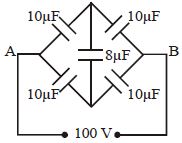
Five capacitors are connected to a $DC$ potential of $100\,V$ as shown in the adjoining figure. Find charge in $10\,μF$ capacitor.......$\mu C$
Medium
Download our app for free and get started

Download our appand get started for free
Experience the future of education. Simply download our apps or reach out to us for more information. Let's shape the future of learning together!No signup needed.*
Similar Questions
- 1If the dielectric constant and dielectric strength be denoted by $k$ and $x$ respectively, then a material suitable for use as a dielectric in a capacitor must haveView Solution
- 2A capacitor of capacitance $C$ is initially charged to a potential difference of $V$ $volt$. Now it is connected to a battery of $2V$ with opposite polarity. The ratio of heat generated to the final energy stored in the capacitor will beView Solution
- 3Two identical capacitors are joined in parallel, charged to potential $V$, separated and then, connected in series, $i.e.$, the positive plate of one is connected to the negative plate of the other. ThenView Solution
- 4A capacitor of capacitance $6\,\mu \,F$ is charged upto $100$ $volt$. The energy stored in the capacitor is........$Joule$View Solution
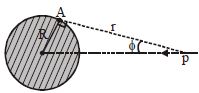
- 5A dipole having dipole moment $p$ is placed in front of a solid uncharged conducting sphere as shown in the diagram. The net potential at point $A$ lying on the surface of the sphere is :-View Solution
- 6$64$ identical drops each charged upto potential of $10\,mV$ are combined to form a bigger dorp. The potential of the bigger drop will be $..........\,mV$View Solution
- 7If $q$ is the charge per unit area on the surface of a conductor, then the electric field intensity at a point on the surface isView Solution
- 8A uniform electric field pointing in positive $x$-direction exists in a region. Let $A$ be the origin, $B$ be the point on the $x$-axis at $x = + 1$ $cm$ and $C$ be the point on the $y$-axis at $y = + 1\,cm$. Then the potentials at the points $A$, $B$ and $C$ satisfyView Solution
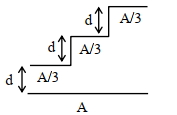
- 9A capacitor is made of a tlat plate of area $A$ and a second plate having a stair-like structure as shown in figure. If the area of each stair is $\frac{A}{3}$ and the height is $\mathrm{d}$, the capacitance of the arrangement is:View Solution
- 10A particle of mass $m$ having negative charge $q$ move along an ellipse around a fixed positive charge $Q$ so that its maximum and minimum distances from fixed charge are equal to $r_1$ and $r_2$ respectively. The angular momentum $L$ of this particle isView Solution