A particle of mass $m$ having negative charge $q$ move along an ellipse around a fixed positive charge $Q$ so that its maximum and minimum distances from fixed charge are equal to $r_1$ and $r_2$ respectively. The angular momentum $L$ of this particle is
Diffcult
Download our app for free and get started
$\frac{1}{2} m V_{1}^{2}-\frac{K Q q}{r_{1}}=\frac{1}{2} m V_{2}^{2}-\frac{K Q q}{r_{2}}$
$\mathrm{mV}_{1} \mathrm{r}_{1}=\mathrm{L}_{0}$
$\mathrm{mV}_{2} \mathrm{r}_{2}=\mathrm{L}_{0}$
Solving eqns:
$L=\sqrt{\frac{m r_{1} r_{2} Q q}{2 \pi \varepsilon_{0}\left(r_{1}+r_{2}\right)}}$

Download our appand get started for free
Experience the future of education. Simply download our apps or reach out to us for more information. Let's shape the future of learning together!No signup needed.*
Similar Questions
- 1A dielectric slab of thickness $d$ is inserted in a parallel plate capacitor whose negative plate is at $x = 0$ and positive plate is at $x = 3d$. The slab is equidistant from the plates. The capacitor is given some charge. As one goes from $0$ to $3d$View Solution
- 2If there are $n$ capacitors in parallel connected to $V$ volt source, then the energy stored is equal toView Solution
- 3The capacities of two conductors are ${C_1}$ and ${C_2}$ and their respective potentials are ${V_1}$ and${V_2}$. If they are connected by a thin wire, then the loss of energy will be given byView Solution
- 4This question contains Statement$-1$ and Statement$-2$. Of the four choices given after the statements, choose the one that best describes the two statements.View Solution
Statement$-1$ : For a charged particle moving from point $P$ to point $Q$, the net work done by an electrostatic field on the particle is independent of the path connecting point $P$ to point $Q$.
Statement$-2$ : The net work done by a conservative force on an object moving along a closed loop is zero. - 5A potential difference of $300\, volts$ is applied to a combination of $2.0\,\mu F$ and $8.0\,\mu F$ capacitors connected in series. The charge on the $2.0\,\mu F$ capacitor isView Solution
- 6A charge of $8\; mC$ is located at the origin. Calculate the work done in $J$ in taking a small charge of $-2 \times 10^{-9} \;C$ from a point $P (0,0,3\; cm )$ to a point $Q (0,4\; cm , 0),$ via a point $R (0,6\; cm , g \;cm )$View Solution
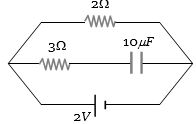
- 7The charge on a capacitor of capacitance $10\,\mu F$ connected as shown in the figure is.......$\mu C$View Solution
- 8View SolutionOne plate of parallel plate capacitor is smaller than other, then charge on smaller plate will be
- 9$1000$ small water drops each of capacitance $C$ join together to form one large spherical drop. The capacitance of bigger sphere is ......... $C$View Solution
- 10A block of mass $m$ moving with speed $v$ compresses a spring through distance $x$ before its speed is halved. What is the value of spring constant ?View Solution