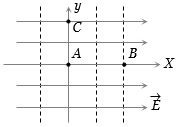
A uniform electric field pointing in positive $x$-direction exists in a region. Let $A$ be the origin, $B$ be the point on the $x$-axis at $x = + 1$ $cm$ and $C$ be the point on the $y$-axis at $y = + 1\,cm$. Then the potentials at the points $A$, $B$ and $C$ satisfy
IIT 2001, Easy


Download our appand get started for free
Experience the future of education. Simply download our apps or reach out to us for more information. Let's shape the future of learning together!No signup needed.*
Similar Questions
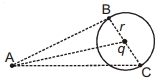
- 1A point charge $q$ is held at the centre of a circle of radius $r . B, C$ are two points on the circumference of the circle and $A$ is a point outside the circle. If $W_{A B}$ represents work done by electric field in taking a charge $q_0$ from $A$ to $B$ and $W_{A C}$ represents the workdone from $A$ to $C$, thenView Solution
- 2An air filled parallel plate capacitor has capacity $C$. If distance between plates is doubled and it is immersed in a liquid then capacity becomes twice. Dielectric constant of the liquid isView Solution
- 3The force between the plates of a parallel plate capacitor of capacitance $C$ and distance of separation of the plates $d$ with a potential difference $V$ between the plates, isView Solution
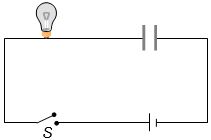
- 4A light bulb, a capacitor and a battery are connected together as shown here, with switch $S$ initially open. When the switch $S$ is closed, which one of the following is trueView Solution
- 5$n$ identical condensers are joined in parallel and are charged to potential $V$. Now they are separated and joined in series. Then the total energy and potential difference of the combination will beView Solution
- 6View SolutionThe capacity of parallel plate condenser depends on
- 7The figure shows a family of parallel equipotential surfaces and four paths along which an electron is made to move from one surface to another as shown in the figurView Solution
$(I)$ What is the direction of the electric field ?
$(II)$ Rank the paths according to magnitude of work done, greatest first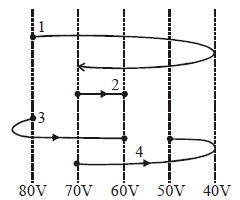
- 8Dipole having dipole moment $4\,C-m$ is placed on origin along $x-$ axis. Point charge of $8\,\mu C$ is fixed at $(4, 0, 0)$ . Now dipole is rotated by an angle of $\frac{\pi }{2}$ . Find the work done (in $mJ$ ) in rotating the dipole.......$mJ$View Solution
- 9In a uniform electric field, the potential is $10$ $V $ at the origin of coordinates, and $8$ $V$ at each of the points $(1, 0, 0), (0, 1, 0) $ and $(0, 0, 1)$. The potential at the point $(1, 1, 1)$ will be....$V$View Solution
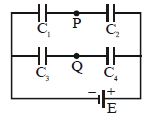
- 10The potential difference between the points $P$ and $Q$ in the adjoining circuit will be :-View Solution