Five identical plates each of area $A$ are joined as shown in the figure. The distance between the plates is $d$. The plates are connected to a potential difference of $V\;volts$. The charge on plates $1$ and $4$ will be
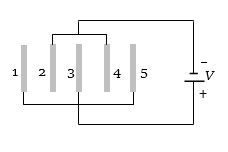
IIT 1984, Diffcult
Download our app for free and get started
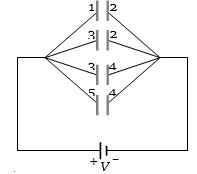
(c)The given circuit can be redrawn as follows. All capacitors are identical and each having capacitance $C = \frac{{{\varepsilon _0}A}}{d}$
|Charge on each capacitor $| = |$ Charge on each plate|
$ = \frac{{{\varepsilon _0}A}}{d}V$
Plate $1$ is connected with positive terminal of battery so charge on it will be $ + \frac{{{\varepsilon _0}A}}{d}.V$
Plate $4$ comes twice and it is connected with negative terminal of battery, so charge on plate $4$ will be $ - \frac{{2{\varepsilon _0}A}}{d}V$
|Charge on each capacitor $| = |$ Charge on each plate|
$ = \frac{{{\varepsilon _0}A}}{d}V$
Plate $1$ is connected with positive terminal of battery so charge on it will be $ + \frac{{{\varepsilon _0}A}}{d}.V$
Plate $4$ comes twice and it is connected with negative terminal of battery, so charge on plate $4$ will be $ - \frac{{2{\varepsilon _0}A}}{d}V$

Download our appand get started for free
Experience the future of education. Simply download our apps or reach out to us for more information. Let's shape the future of learning together!No signup needed.*
Similar Questions
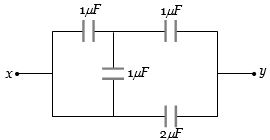
- 1Four capacitors are connected as shown in the figure. Their capacities are indicated in the figure. The effective capacitance between points $x$ and $y$ is (in $\mu F$)View Solution
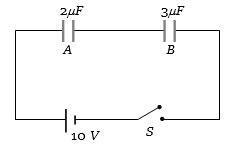
- 2Two capacitors $A$ and $B$ are connected in series with a battery as shown in the figure. When the switch $S$ is closed and the two capacitors get charged fully, thenView Solution
- 3View SolutionConsidering a group of positive charges, which of the following statements is correct?
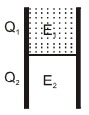
- 4A parallel plate capacitor has a dielectric slab of dielectric constant $K$ between its plates that covers $1 / 3$ of the area of its plates, as shown in the figure. The total capacitance of the capacitor is $C$ while that of the portion with dielectric in between is $C _1$. When the capacitor is charged, the plate area covered by the dielectric gets charge $Q_1$ and the rest of the area gets charge $Q_2$. Choose the correct option/options, igonoring edge effects.View Solution
$(A)$ $\frac{E_1}{E_2}=1$ $(B)$ $\frac{E_1}{E_2}=\frac{1}{K}$ $(C)$ $\frac{Q_1}{Q_2}=\frac{3}{K}$ $(D)$ $\frac{ C }{ C _1}=\frac{2+ K }{ K }$
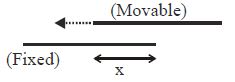
- 5A parallel-plate capacitor consists of a fixed plate and a movable plate that is allowed to slide in the direction parallel to the plates. Let $x$ be the distance of overlap, as shown in the figure. The separation between the plates is fixed. Assume that the plates are electrically isolated, so that their charges $±Q$ are constant. Force on the movable plate is proportional toView Solution
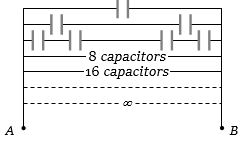
- 6An infinite number of identical capacitors each of capacitance $1\,\mu F$ are connected as in adjoining figure. Then the equivalent capacitance between $A$ and $B$ is......$\mu F$View Solution
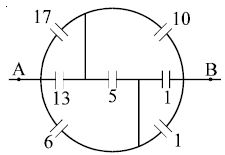
- 7Find equivalent capacitance across $AB$.....$ \mu F$ (all capacitances in $\mu F$)View Solution
- 8Two mutually perpendicular infinitely long straight conductors carrying uniformly distributed charges of linear densities $\lambda_{1}$ and $\lambda_{2}$ are positioned at a distance $r$ from each other. Force between the conductors depends on $r$ asView Solution
- 9View SolutionFor the circuit shown, which of the following statements is true
- 10A conducting sphere of radius $R$ is given a charge $Q.$ The electric potential and the electric field at the centre of the sphere respectively areView Solution