MCQ
Flux passing through loop is proportional to
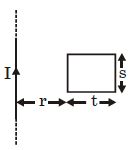
  • A
    $\phi \propto  r$
  • $\phi \propto  s$
  • C
    $\phi \propto  t$
  • D
    $\phi \propto  r^{-1}$

Answer

Correct option: B.
$\phi \propto  s$
b
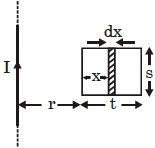
$\int \mathrm{d} \phi=\int_{0}^{\mathrm{t}} \frac{\mu_{0} \mathrm{I}}{2 \pi(\mathrm{r}+\mathrm{x})} \cdot \mathrm{s}\,\, \mathrm{dx}$

$\phi=\frac{\mu_{0} \mathrm{Is}}{2 \pi} \int_{0}^{t} \frac{\mathrm{d} \mathrm{x}}{\mathrm{r}+\mathrm{x}}$

$\phi=\frac{\mu_{0} \mathrm{Is}}{2 \pi} \ln (\mathrm{r}+\mathrm{x}) \mathrm{l}_{0}^{\mathrm{t}}$

$\phi=\frac{\mu_{0} \mathrm{Is}}{2 \pi} \ln \left(\frac{r+\mathrm{t}}{\mathrm{r}}\right)$

$\phi \propto S$
Need a full question paper?

Generate a complete, print-ready paper with questions like this in minutes — across 16+ boards, with answer keys.
Start Generating Free

Similar questions

Electric charges of $+10\,\mu\, C, +5\,\mu\, C, -3\,\mu\, C$ and $+8\,\mu\, C$ are placed at the corners of a square of side$\sqrt 2\,m$ . The potential at the centre of the square is
If the coefficient of mutual induction of the primary and secondary coils of an induction coil is $5\, H$ and a current of $10\, A$ is cut off in $5\times10^{-4}\, s$, the $emf$ inducted (in $volt$) in the secondary coil is
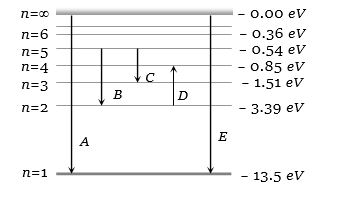
The energy levels of the hydrogen spectrum is shown in figure. There are some transitions $A, B, C, D$ and $E.$ Transition $A, B$ and $C$ respectively represent
If the kinetic energy of a free electron doubles, its de-Broglie wavelength changes by the factor
A hydrogen atom makes a transition from $n = 2$ to  $n = 1$ and emits a photon. This photon strikes a doubly ionized lithium atom $(z = 3)$  in excited state and completely removes the orbiting electron. The least quantum number for the excited state of the ion for the process is
If $P$ and $Q$ are two batteries connected in series with anode of one connected to anode of the other, producing voltages $E_1$ and $E_2>E_1$ respectively. The e.m.f of the pair is
The voltage of $AC$ source varies with time according to the equation, $V = 100\, \sin 100\, \pi \, t \, \cos \,100\, \pi \,t$. Where $t$ is in second and $V$ is in volt. Then:-
A cell of internal resistance $r$ is connected to an external resistance $R.$ The current will be maximum in $R$, if:
A wire of length 5 m and radius 1 mm has a resistance of 1 ohm. What length of the wire of the same material at the same temperature and of radius 2 mm will also have a resistance of 1 ohm
Bragg’s law for $X-$ rays is