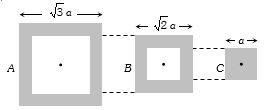
Following figure shows cross-sections through three long conductors of the same length and material, with square cross-section of edge lengths as shown. Conductor $B$ will fit snugly within conductor $A$, and conductor $C$ will fit snugly within conductor $B$. Relationship between their end to end resistance is
Medium
Download our app for free and get started
(a) All the conductors have equal lengths. Area of cross-section of $A$ is $\{ {(\sqrt 3 \,a)^2} - {(\sqrt 2 \,a)^2}\} = {a^2}$
Similarly area of cross-section of $B=$ Area of cross-section of $C = a^2$
Hence according to formula $R = \rho \frac{l}{A};$ resistances of all the conductors are equal i.e.$ R_A = R_B = R_C$

Download our appand get started for free
Experience the future of education. Simply download our apps or reach out to us for more information. Let's shape the future of learning together!No signup needed.*
Similar Questions
- 1A battery of $24\,cells$ , each of emf $1.5\,V$ and internal resistance $2\,\Omega$ is to be connected in order to send the maximum current through a $12\,\Omega$ resistor. The correct arrangement of cells will beView Solution
- 2The effective resistance of two resistors in parallel is $\frac{{12}}{7}\,\Omega $. If one of the resistors is disconnected the resistance becomes $4$ $\Omega$. The resistance of the other resistor is.............. $\Omega$View Solution
- 3The battery in the diagram is to be charged by the generator $G$. The generator has a terminal voltage of $120$ $\mathrm{volts}$ when the charging current is $10$ $\mathrm{amperes}.$ The battery has an $\mathrm{emf}$ of $100$ $\mathrm{volts}$ and an internal resistance of $1$ $\mathrm{ohm}.$ In order to charge the battery at $10$ $\mathrm{amperes}$ charging current, the resistance $R$ should be set at ................ $\Omega$View Solution
- 4For a wire $\frac{R}{l}=\frac{1}{2}$ and length of wire is $l=5\, cm .$ If potential difference $1\, V$ is applied across it, current through wire will be: $( R =$ Resistance $)$ (in $A$)View Solution
- 5What is the equivalent resistance between $A$ and $B$View Solution
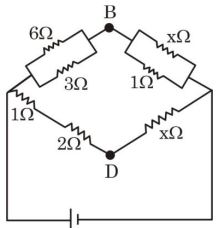
- 6If the potential difference between $B$ and $D$ is zero, the value of $x$ is $\frac{1}{n} \Omega$. The value of $n$ is .......View Solution
- 7A $1\,m$ long wire is broken into two unequal parts $X$ and $Y$ The $X$ part of the wire is streched into another wire $W$. Length of $W$ is twice the length of $X$ and the resistance of $W$ is twice that of $Y$. Find the ratio of length of $X$ and $Y$.View Solution
- 8If two bulbs of wattage $25$ and $30$, each rated at $220\, volts$, are connected in series with a $440$ $volt$ supply, which bulb will fuseView Solution
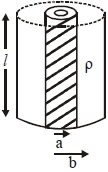
- 9Model a torch battery of length $l$ to be made up of a thin cylindrical bar of radius $'a'$ and a concentric thin cylindrical shell of radius ' $b$ ' fille in between with an electrolyte of resistivity $\rho$ (see figure). If the battery is connected to a resistance of value $R ,$ the maximum Joule heating in $R$ will take place forView Solution
- 10The circuit shown has been connected for a long time. The voltage across the capacitor is ............. $V$View Solution