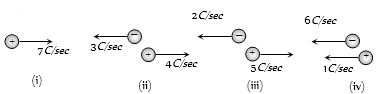
Following figure shows four situations in which positive and negative charges moves horizontally through a region and gives the rate at which each charge moves. Rank the situations according to the effective current through the region greatest first
Medium
Download our app for free and get started
(c) For figure $(i)$ ${i_1} = 7A$
For figure $(ii)$ ${i_2} = 4 + 3 = 7A$
For figure $(iii)$ ${i_3} = 5 + 2 = 7A$
For figure $(iv)$ ${i_4} = 6 - 1 = 5A$
For figure $(ii)$ ${i_2} = 4 + 3 = 7A$
For figure $(iii)$ ${i_3} = 5 + 2 = 7A$
For figure $(iv)$ ${i_4} = 6 - 1 = 5A$

Download our appand get started for free
Experience the future of education. Simply download our apps or reach out to us for more information. Let's shape the future of learning together!No signup needed.*
Similar Questions
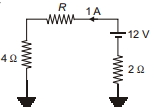
- 1Value of the resistance $R$ in the figure is .......... $\Omega$View Solution
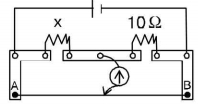
- 2A meter bridge is set up as shown, to determine an unknown resistance ' $X$ ' using a standard $10\,ohm$ resistor. The galvanometer shows null point when tapping-key is at $52\,cm$ mark. The endcorrections are $1\,cm$ and $2\,cm$ respectively for the ends $A$ and $B$. The determined value of ' $X$ ' is $..........\Omega$View Solution
- 3View SolutionFor measurement of potential difference, potentiometer is preferred in comparison to voltmeter because
- 4A potentiometer wire of length $100\, cm$ has a resistance of $10\,\Omega $. It is connected in series with a resistance and a cell of $emf$ $2\, V$ and of negligible internal resistance. A source of $emf$ $10\,mV$ is balanced against a length of $40\, cm$ of the potentiometer wire. What is the value of external resistance ? .................. $\Omega$View Solution
- 5If ${R_1}$ and ${R_2}$ are respectively the filament resistances of a $200$ $watt$ bulb and $100$ $watt$ bulb designed to operate on the same voltage, thenView Solution
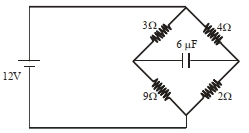
- 6In the circuit shown, the energy stored in the capacitor is $n\,\mu J$. The value of $n$ is ..............View Solution
- 7A railway compartment is lit up by thirteen lamps each taking $2.1\, amp$ at $15\, volts$. The heat generated per second in each lamp will be ............ $cal$View Solution
- 8View SolutionResistance of one carbon filament and one tungsten lamp are measured individually when the lamp are lit and compared with their respective resistances when cold. Which one of the following statements will be true
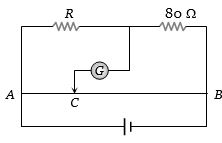
- 9$AB$ is a wire of uniform resistance. The galvanometer $G$ shows no current when the length $AC = 20\,cm$ and $CB = 80\, cm$. The resistance $R$ is equal to .............. $\Omega $View Solution
- 10Space between two concentric conducting spheres of radii $a$ and $b (b > a)$ is filled with $a$ medium of resistivity $\rho $. The resistance between the two spheres will beView Solution