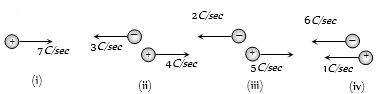
Following figure shows four situations in which positive and negative charges moves horizontally through a region and gives the rate at which each charge moves. Rank the situations according to the effective current through the region greatest first
Medium


Download our appand get started for free
Experience the future of education. Simply download our apps or reach out to us for more information. Let's shape the future of learning together!No signup needed.*
Similar Questions
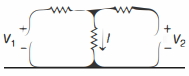
- 1Two batteries $V_1$ and $V_2$ are connected to three resistors as shown below. If $V_1=2 \,V$ and $V_2=0 \,V$, then the current $I=3 \,mA$. If $V_1=0 \,V$ and $V_2=4 \,V$, then the current $I=4 \,mA$. Now, if $V_1=10 \,V$ and $V_2=10 \,V$, then the current $I$ will be ............ $\,mA$View Solution
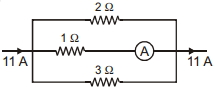
- 2The ammeter reading in the circuit below is .............. $A$View Solution
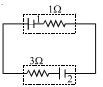
- 3In the figure shown, battery $1$ has $\mathrm{emf}$ $= 6\, V$ and internal resistance $= 1 \,\Omega$. Battery $2$ has $\mathrm{emf}$ $= 2\,V$ and internal resistance $= 3\, \Omega$ . The wires have negligible resistance. What is the potential difference across the terminals of battery $2$ ? ................ $V$View Solution
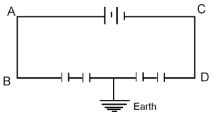
- 4Four equal capacitors are connected to a battery as shown in the adjoining figure. The potential of $A$ and $B$ areView Solution
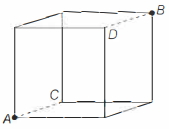
- 5A cube is formed with ten identical resistances $R$ (thick lines) and two shorting wires (dotted lines) along the arms $A C$ and $B D$ as shown in the figure below. Resistance between point $A$ and $B$ is ...........$\Omega$View Solution
- 6A current of $10 \,A$ is maintained in a conductor of cross-section $1 \,cm ^2$. If the number density of free electrons be $9 \times 10^{28} \,m ^{-3}$, the drift velocity of free electrons is .......... $m / s$View Solution
- 7A current through a wire depends on time as $i =\alpha_{0} t +\beta t ^{2}$ where $\alpha_{0}=20 A / s$ and $\beta=8 As ^{-2} .$ Find the charge crossed through a section of the wire in $15 \,s$ (in $C$)View Solution
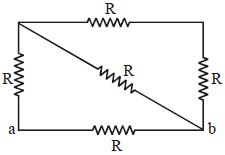
- 8Find out the equivalent resistance between the points $a$ and $b$View Solution
- 9View SolutionAssertion : In a simple battery circuit, the point of the lowest potential is negative terminal of the battery.
Reason : The current flows towards the point of the higher potential, as it does in such a circuit from the negative to the positive terminal.
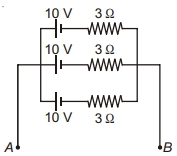
- 10Three identical cells are connected in parallel across $A B$. Net emf across $A B$ is .......... $V$View Solution