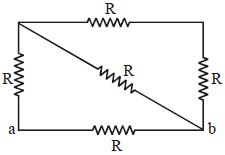
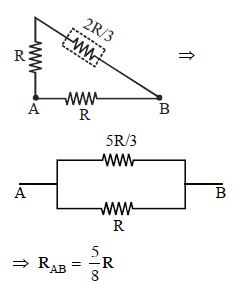
Find out the equivalent resistance between the points $a$ and $b$
Medium


Download our appand get started for free
Experience the future of education. Simply download our apps or reach out to us for more information. Let's shape the future of learning together!No signup needed.*
Similar Questions
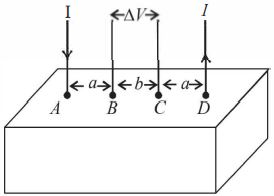
- 1Consider a block of conducting material ofresistivity '$\rho$' shown in the figure. Current '$I$' enters at '$A$' and leaves from '$D$'. We apply superp osition principle to find voltage '$\Delta V$ ' developed between '$B$' and '$C$'. The calculation is done in the following steps:View Solution
$(i)$ Take current '$I$' entering from '$A$' and assume it to spread over a hemispherical surface in the block.
$(ii)$ Calculatefield $E(r)$ at distance '$r$' from $A$ by using Ohm's law $E = \rho j$, where j is the current per unit area at '$r$'.
(iii) From the '$r$' dependence of $E(r)$, obtain the potential $V(r)$ at $r$.
(iv) Repeat $(i), (ii)$ and $(iii)$ for current '$I$' leaving '$D$' and superpose results for '$A$' and '$D$'.$\Delta V$ measured between $B$ and $C$ is
- 2A $1\,m$ long wire is broken into two unequal parts $X$ and $Y$ The $X$ part of the wire is streched into another wire $W$. Length of $W$ is twice the length of $X$ and the resistance of $W$ is twice that of $Y$. Find the ratio of length of $X$ and $Y$.View Solution
- 3A battery of internal resistance one ohm and $emf$ $3\,volt$ sends a current through $1\,metre$ of uniform wire of resistance $5\,\Omega $. The pole of the cell of $emf$ $1.4\,volt$ are connected to two points on the wire so that no current passes through this cell. Then, the potential gradient of the wire isView Solution
- 4A battery has $e.m.f.$ $4\, V$ and internal resistance $r$. When this battery is connected to an external resistance of $2\, ohms$, a current of $1\, amp$. flows in the circuit. How much current will flow if the terminals of the battery are connected directly .......... $amp$View Solution
- 5In an electrical cable there is a single wire of radius $9\, mm$ of copper. Its resistance is $5\,\Omega $. The cable is replaced by $6$ different insulated copper wires, the radius of each wire is $3\,mm$. Now the total resistance of the cable will be ............... $\Omega$View Solution
- 6Consider a metallic cube of edge length $L$. Its resistance, $R$, measured across its opposite faces is $R =\frac{ m _{ e } v }{ ne ^2 L ^2}$, where $n$ is the number density and $v$ is the drift speed of electrons in the cube, and $e$ and $m _{ e }$ are the charge and mass of an electron respectively. Assuming the de-Broglie wavelength of the electron to be $L$, the maximum resistance of the sample is closest to ............. $\,\Omega$ $\left(e=1.60 \times 10^{-19} \,C ; m _{ e }=9.11 \times 10^{-31} \,kg\right.$; Planck's constant, $h=6.63 \times 10^{-34} \,Js$ )View Solution
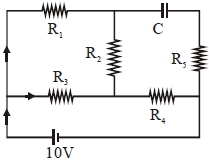
- 7An ideal cell of emf $10\, V$ is connected in circuit shown in figure. Each resistance is $2\, \Omega .$ The potential difference (in $V$) across the capacitor when it is fully charged isView Solution
- 8The resistivity $(\rho)$ of semiconductor varies with temperature. Which of the following curve represents the correct behaviourView Solution
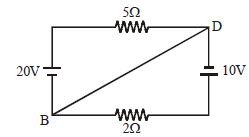
- 9Calculate the current in wire $BD$ ................ $A$View Solution
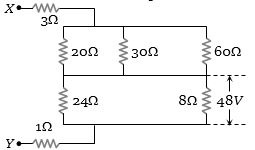
- 10The potential difference across $8\, ohm$ resistance is $48\, volt$ as shown in the figure. The value of potential difference across $X$ and $Y$ points will be ............. $volt$View Solution