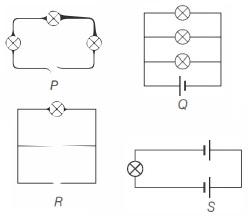
Following figures show different combinations of identical bulb$(s)$ connected to identical battery$(ies)$. Which option is correct regarding the total power dissipated in the circuit?
KVPY 2012, Diffcult
Download our app for free and get started
(d)
Power consumed in each case is
$( Q )$ $P=\frac{V^2}{R / 3}=\frac{3 V^2}{R}$
$( P )$ $P=\frac{V^2}{3 R}$
$( R )$ $P=\frac{V^2}{R}$
$( S )$ $P=\frac{(2 V)^2}{R}=\frac{4 V^2}{R}$
So, order of increasing power consumption is $P > R > Q > S$.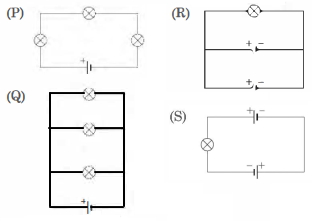

Download our appand get started for free
Experience the future of education. Simply download our apps or reach out to us for more information. Let's shape the future of learning together!No signup needed.*
Similar Questions
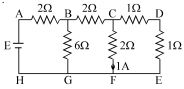
- 1The figure shows a network of resistors and $a$ battery. If $1\,A$ current flowsthrough the branch $CF$, then answer the following questions The current throughView Solution
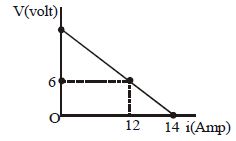
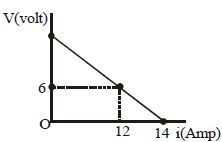
- 2$10\, Cells$, each of $emf$ $'E'$ and internal resistance $'r'$, are connected in series to a variable external resistance. Figure shows the variation of terminal potential difference of their combination with the current drawn from the combination.$Emf$ of each cell is ................ $V$View Solution
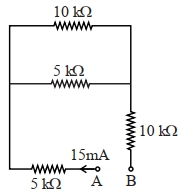
- 3A current of $15\,mA$ flows in the circuit as shown in figure. The value of potential difference between the points $A$ and $B$ will be $...\,V$View Solution
- 4View SolutionKirchhoff's second law is based on the law of conservation of
- 5Water of volume $2\, litre$ in a container is heated with a coil of $1\, kW$ at $27 \,^oC$. The lid of the container is open and energy dissipates at rate of $160\, J/s$. In how much time temperature will rise from $27\,^oC$ to $77\,^oC$ $[$ Given specific heat of water is $4.2\, kJ/kg$ $]$View Solution
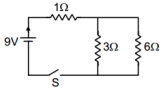
- 6After switch is closed, current drawn from the battery is (in $A$)View Solution
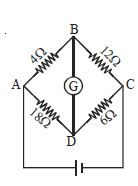
- 7View SolutionIn the following diagram the wheat stone bridge is balanced when we interchange the resistances of
- 8$10\,Cells$, each of emf $'E'$ and internal resistance $'r'$, are connected in series to a variable external resistance. Figure shows the variation of terminal potential difference of their combination with the current drawn from the combination.$Emf$ of each cell is ............. $V$View Solution
- 9View SolutionThe electric current passing through a metallic wire produces heat because of
- 10The effective resistance between the points $A$ and $B$ in the figure is ............. $\Omega$View Solution