MCQ
Following gases are kept at the same temperature. Which gas possesses maximum r.m.s. speed?
  • A
    Oxygen
  • B
    Nitrogen
  • Hydrogen
  • D
    Carbon dioxide

Answer

Correct option: C.
Hydrogen
Out of all gases, hydrogen gas has the minimum molecular mass, therefore hydrogen gas will have the highest $\text{r.m.s}$ speed.

Need a full question paper?

Generate a complete, print-ready paper with questions like this in minutes — across 16+ boards, with answer keys.

Start Generating Free

Similar questions

Assuming the sun to have a spherical outer surface of radius $r$, radiating like a black body at temperature $t^o C$, the power received by a unit surface, (normal to the incident rays) at a distance $R$ from the centre of the sun is

where $\sigma$ is the Stefan's constant.
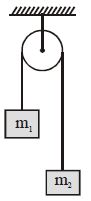
Two masses $m_1 = 3\,kg$ and $m_2 = 7\,kg$ tied to a string are hanging over a light frictionless pulley. What is the acceleration of the masses when system is free to move ? $[g = 10\,m/s^2]$  ...... $m/s^2$
A uniform metal chain is placed on a rough table such that one end of chain hangs down over the edge of the table. When one-third of its length hangs over the edge, the chain starts sliding. Then, the coefficient of static friction is
A particle is moving along a curve. Then
The mass and length of a wire are $M$ and $L$ respectively. The density of the material of the wire is $d$. On applying the force $F$ on the wire, the increase in length is $l$, then the Young's modulus of the material of the wire will be
A ball is thrown up at an angle with the horizontal. Then, the total change of momentum by the instant it returns to the ground is
Dimensions of the following three quantities are the same
In the figure shown, the two identical balls of mass $M$ and radius $R$ each, are placed in contact with each other on the frictionless horizontal surface. The third ball of mass $M$ and radius $R/2$, is coming down vertically and has a velocity $= v_0$ when it simultaneously hits the two balls and the smaller ball does not stop after collision, but continues to move downwards with $a$ speed $= v_0/2$, after the collision. Then, the speed of each bigger ball after collision is
The position vector of a particle is given as $\vec r\, = \,({t^2}\, - \,8t\, + \,12)\,\hat i\,\, + \,\,{t^2}\hat j$ The time after which velocity vector and acceleration vector becomes perpendicular to each other is equal to........$sec$
The resultant of $\overrightarrow{\text{A}}$ and $\overrightarrow{\text{B}}$ makes an angle a with $\overrightarrow{\text{A}}$ and $\beta$ with $\overrightarrow{\text{B}},$