MCQ
For a ball falling in a liquid with constant velocity, ratio of resistance force due to the liquid to that due to gravity is:
  • $1$
  • B
    $\frac{2\text{a}^2\rho\text{g}}{9\eta^2}$
  • C
    $\frac{2\text{a}^2(\rho-\sigma)\text{g}}{9\eta}$
  • D
    $\text{None.}$

Answer

Correct option: A.
$1$

Need a full question paper?

Generate a complete, print-ready paper with questions like this in minutes — across 16+ boards, with answer keys.
Start Generating Free

Similar questions

Two forces of $10 \,N$ and $6 \,N$ act upon a body. The direction of the forces are unknown. The resultant force on the body may be .........$N$
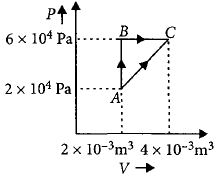
Figure below shows two paths that may be taken by a gas to go from a state $A$ to a state $C.$ In process $AB,$ $400 \,J$ of heat is added to the system and in process $BC,$ $100\, J$ of heat is added to the system. The heat absorbed by the system in the process $AC$ will be ...... $J$
If two moles of diatomic gas and one mole of mono atomic gas are mixed then the ratio of specific heats $\gamma=$ ......
Given below are two statements:

Statement $I :$ In a diatomic molecule, the rotational energy at a given temperature obeys Maxwell's distribution.

Statement $II :$ In a diatomic molecule, the rotational energy at a given temperature equals the translational kinetic energy for each molecule.

In the light of the above statements, choose the correct answer from the options given below:

In isothermal process, the work done per gram molecule of gas is:
Jet aircrafts fly at altitudes above $30000 \,ft$, where the air is very cold at $-40^{\circ} C$ and the pressure is $0.28 \,atm$. The cabin is maintained at $1 \,atm$ pressure by means of a compressor which exchanges air from outside adiabatically. In order to have a comfortable cabin temperature of $25^{\circ} C$, we will require in addition 
A car moves for $60\ s$ covering a distance of $3600\ m$ with zero initial velocity. What is the acceleration in $m/ s^2?$
Two damped spring-mass oscillating systems have identical spring constants and decay times. However, system $A's$ mass $m_A$ is twice system $B's$ mass $m_B$ . How do their damping constants, $b$ , compare ?
Measure of two quantities along with the precision of respective measuring instrument  $A = 2.5\,m{s^{ - 1}} \pm 0.5\,m{s^{ - 1}}$, $B = 0.10\,s \pm 0.01\,s$ The value of $AB$ will be
A rocket is fired vertically up from the ground with a resultant vertical acceleration of $10\  m/s^2$. The fuel is finished in $1\  minute$ and it continues to move up.$(a)$ the maximum height reached.$(b)$ After how much time from then will the maximum height be reached (Take $g = 10\  m/s^2$)