MCQ
Two damped spring-mass oscillating systems have identical spring constants and decay times. However, system $A's$ mass $m_A$ is twice system $B's$ mass $m_B$ . How do their damping constants, $b$ , compare ?
  • A
    $b_A = 4b_B$
  • B
    $b_A = 2b_B$
  • C
    $b_A = b_B$
  • ${b_A} = \frac{1}{2}{b_B}$

Answer

Correct option: D.
${b_A} = \frac{1}{2}{b_B}$
d
Damping coefficient $=2 \sqrt{\mathrm{km}}$

$=2 \mathrm{m} \omega$

$\alpha \mathrm{m}$

$\mathrm{m}_{\mathrm{A}}=\mathrm{m}$     $\mathrm{m}_{\mathrm{B}}=\frac{\mathrm{m}}{2}$

$\frac{b_{A}}{b_{B}}=\frac{1}{2}$

Need a full question paper?

Generate a complete, print-ready paper with questions like this in minutes — across 16+ boards, with answer keys.

Start Generating Free

Similar questions

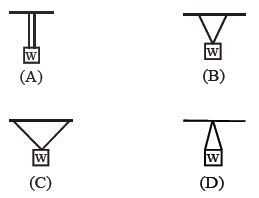
A weight can be hung in any of following four ways by using same string. In which case is  the string more likely to break is :-
A body of mass $100 g$ is rotating in a circular path of radius $r$ with constant velocity. The work done in one complete revolution is
The phenomenon of Browninan movement may be taken as evidence of:
Two springs of force constants $300\, N / m$ (Spring $A$) and $400$ $N / m$ (Spring $B$ ) are joined together in series. The combination is compressed by $8.75\, cm .$ The ratio of energy stored in $A$ and $B$ is $\frac{E_{A}}{E_{B}} .$ Then $\frac{E_{A}}{E_{B}}$ is equal to
The dimensional formula of angular velocity is
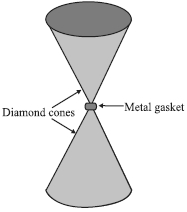
Anvils made of single crystals of diamond, with the shape as shown in Figure, are used to investigate behaviour of materials under very high pressures. Flat faces at the narrow end of the anvil have a diameter of $0.50\; mm$, and the wide ends are subjected to a compressional force of $50,000 \;N$. What is the pressure at the tip of the anvil?
The potential energy of a particle of mass $100 \,g$ moving along $x$-axis is given by $U=5 x(x-4)$, where $x$ is in metre. The period of oscillation is .................
Newton's second law gives the measure of
A particle is moving with constant speed in a circular path. When the particle turns by an angle $90^{\circ}$, the ratio of instantaneous velocity to its average velocity is $\pi: x \sqrt{2}$. The value of $x$ will be $.........$
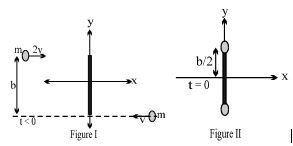
One ice skater of mass $m$ moves with speed $2v$ to the right, while another of the same mass $m$ moves with speed $v$ toward the left, as shown in figure $I$. Their paths are separated by $a$ distance $b$. At $t = 0$, when they are both at $x = 0$, they grasp a pole of length $b$ and negligible mass. For $t > 0$, consider the system as a rigid body of two masses $m$ separated by distance $b$, as shown in figure $II$. Which of the following is the correct formula for the motion after $t = 0$ of the skater initially at $y = b/2?$