Question
For a certain chemical reaction variation in the concentration ln $[R]$ vs. time plot is given alongside.For this reaction:
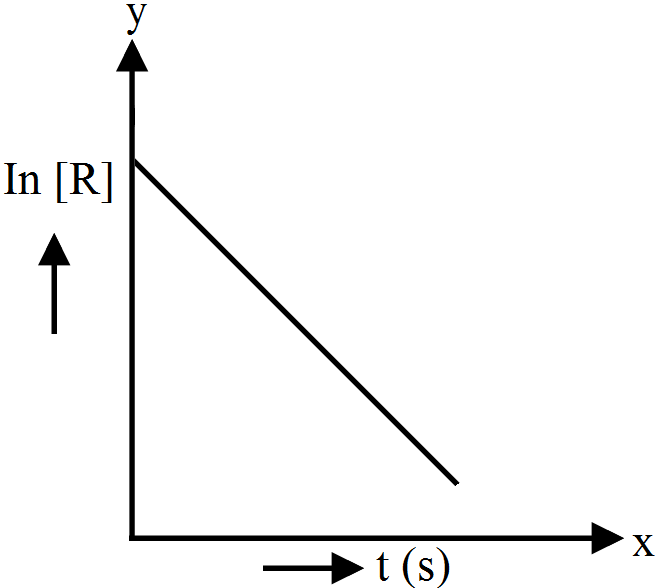
  1. What is the order of the reaction?
  2. What are the units of rate constant $k$?
  3. Give the relationship between $k$ and $t \frac{1}{2}($half$-$life period$).$
  4. What is the slope of the curve?
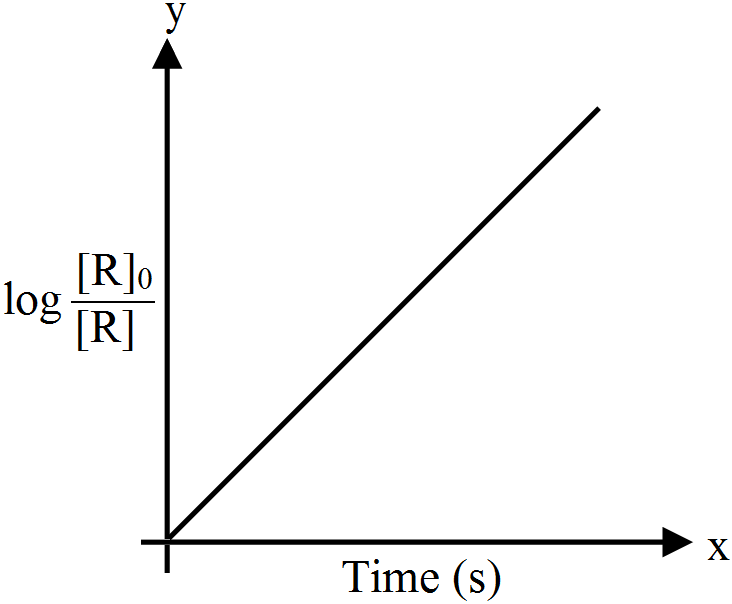
  5. Draw the plot $\log [R]0 /[R]$ vs time $t(s).$
Answer

  1. First order.
  2. Time$^{-1} (s^{-1})$
  3. $\text{k}=\frac{0.693}{\text{t}_{1/2}}$
  4. Slope $= - k ($rate constant$).$
  5.  

Need a full question paper?

Generate a complete, print-ready paper with questions like this in minutes — across 16+ boards, with answer keys.

Start Generating Free

Similar questions

A hydrocarbon $'A', (C_4H_8)$ on reaction with $HCl$ gives a compound $'B', (C_4H_9Cl)$, which on reaction with $1 \ mol$ of $NH_3$ gives compound $'C', (C_4H_{11}N)$. On reacting with $NaNO_2$ and $HCl$ followed by treatment with water, compound $'C\ '$ yields an optically active alcohol,$'D\ '$. Ozonolysis of $'A\ '$ gives $2$ mols of acetaldehyde. Identify compounds $'A\ '$ to $'D\ '$. Explain the reactions involved.
How is osmotic pressure determined by Berkeley-Hartley method ?
Describe the dispersion methods for preparation of colloidal solution.
Attempt any five of the following:
$(a)$ What are Purines and Pyrimidines? Name the purines and Pyrimidines present in $\text{DNA}$ and $\text{RNA}$ nucleic Acids.
$(b)$ Write the full forms of $\text{DNA}$ and $\text{RNA}$.
$(c)$ Name the vitamin whose deficiency causes convulsions.
$(d)$ Which vitamin B group can be stored in our body?
$(e) (i)$. What is the difference between a nucleoside and nucleotide?
$(ii).$ Write one difference between a-helix and $ẞ-$pleated sheet structures of protein.
$(f)$ What are nucleic acids? Why two strands in $\text{DNA}$ are not identical but are complementary?
$(g)$ Some enzymes are named after the reaction, where they are used. What name is given to the class of enzymes which catalyse the oxidation of one substrate with simultaneous reduction of another substrate?
Match the items of Column $I$ and Column $II.$
 
Column $I$
 
Column $II$
$i.$
Lechlanche cell
$a.$
Cell reaction $2H_2 + O_2 ⎯\rightarrow 2H_2O$
$ii.$
$Ni–Cd$ cell
$b.$
Does not involve any ion in solution and is used in hearing aids.
$iii.$
Fuel cell
$c.$
Rechargeable.
$iv.$
Mercury cell
$d.$
Reaction at anode, $Zn ⎯\rightarrow Zn^{2+} + 2e^-$
 
 
$e.$
Converts energy of combustion into electrical energy.
Attempt any five of the following:
$(a)$ Deficiency of which vitamin causes night-blindness.
$(b)$ Give two examples of reducing sugars.
$(c)$ Define the following terms:
$i.$ Glycosidic linkage
$ii.$ Native protein
$(d)$ Write function of carbohydrates in plants.
$(e)$ Differentiate between:
$i.$ Peptide linkage and Glycosidic linkage
$ii.$ Nucleoside and Nucleotide
$(f)$ What type of linkage holds together the monomers of $\text{DNA}$?
$(g)$ Write the product obtained when $D-$glucose reacts with $H_2N-OH.$
  1. Calculate the freezing point of solution when $1.9 g$ of $\ce{MgCl_2(M = 95 g mol^{–1})}$ was dissolved in $50 g$ of water, assuming $MgCl_2$ undergoes complete ionization. $(K_f$​​​​​​​ for water $= 1.86 K \ kg mol^{–1})$
  2. Out of $1 M$ glucose and $2 M$ glucose, which one has a higher boiling point and why?
  3. What happens when the external pressure applied becomes more than the osmotic pressure of solution?
i. Write the structures of main products when benzene diazonium chloride reacts with the following reagents:
a. $H_3PO_2 + Hp$
b. $CuCN/KCN$
c. $H_2O$
ii. Arrange the following in the increasing order of their basic character in an aqueous solution: $\ce{C_2H_5NH_2, (C_2H5)_2NH, (C_2H_5)_3N.}$ Give justification.
Write the applications of d- and f-block elements.
Explain the various uses of lanthanoids.