Question
How is osmotic pressure determined by Berkeley-Hartley method ?

Answer

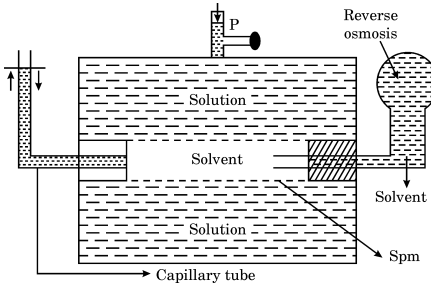
In this method solvent and solution are taken as shown in the figure:
This method is based upon applying pressure on the solution which is just sufficient to prevent the entry of the solvent into the solution through the semi-permeable membrane. A semi-permeable membrane to fit into a bronze cylinder to which the piston is fitted and pressure gauge. The porous tube is fitted with a water reservoir on one side and a capillary indicator on the other side. The porous tube is filled with pure solvent. The bronze cylinder is filled with solution, the osmotic pressure of which is to be measured. As a result of osmosis, solvent in the porous
Image
cylinder tends to pass into solution through semipermeable membrane with the result the level in the capillary indicator moves down-wards. External pressure is then applied by the piston so that solvent level in the capillary becomes stationary. It indicates that osmosis has been stopped and now the pressure recorded by the pressure gauge gives the osmotic pressure of the solution.

Need a full question paper?

Generate a complete, print-ready paper with questions like this in minutes — across 16+ boards, with answer keys.
Start Generating Free

Similar questions

Calculate the depression in the freezing point of water when 10 g of
CH3CH2CHClCOOH is added to 250 g of water. Ka = 1.4 × 10⁻³, Kf = 1.86 K kg mol-1.
Write the $S _{ N } 2$ mechanism of bimolecular nucleophilic substitution.
What is abnormal molar mass? Explain.
  1. Define the following terms:
  1. Mole fraction.
  2. Ideal solution.
  1. $15.0\ g$ of an unknown molecular material is dissolved in $450\ g$ of water. The resulting solution freezes at $- 0.34^\circ C.$ What is the molar mass of the material?
$(K_f$ for water $= 1.86\ K \ kg\ mol^{–1}).$
How to determine the vapour pressure and total pressure of the components in binary solution of two volatile liquids? Explain their mathematical form and also explain the graph between mole fraction and vapour pressure for an ideal solution.
Comment on the statement that elements of the first transition series possess many properties different from those of heavier transition elements.
  1. With reference to structural variability and chemical reactivity, write the differences between lanthanoids and actinoids.
  2. Name a member of the lanthanoid series which is well known to exhibit $+4$ oxidation state.
  3. Complete the following equation:
$\text{MnO}_{4}^{-}+\text{8H}^{+}+\text{5e}^{-}\rightarrow$
  1. Out of $Mn^{3+}$ and $Cr^{3+}$, which is more paramagnetic and why?
$($Atomic nos: $Mn = 25, Cr = 24).$
Complete the following reactions :
(i) $C _6 H _5 NH _2+ CHCl _3+$ alc. $KOH \longrightarrow$
(ii) $C _6 H _5 N_2 Cl + H _3 PO _2+ H _2 O \longrightarrow$
(iii) $C _6 H _5 NH _2+ H _2 SO _4$ (conc.) ⟶
(iv) $C _6 H _5 N_2 Cl + C _2 H _5 OH \longrightarrow$
(v) $C _6 H _5 NH _2+ Br _2(a q) \longrightarrow$
Describe the common name system and IUPAC system of naming amines.