For a metallic wire, the ratio $V/i$ ($V = $ the applied potential difference, $i$ = current flowing) is
Easy


Download our appand get started for free
Experience the future of education. Simply download our apps or reach out to us for more information. Let's shape the future of learning together!No signup needed.*
Similar Questions
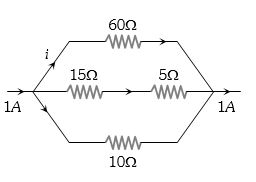
- 1The magnitude of $i$ in ampere unit isView Solution
- 2Space between two concentric conducting spheres of radii $a$ and $b (b > a)$ is filled with $a$ medium of resistivity $\rho $. The resistance between the two spheres will beView Solution
- 3A potentiometer consists of a wire of length $4\, m$ and resistance $10\,\Omega $. It is connected to a cell of $e.m.f.$ $2\, V$. The potential difference per unit length of the wire will be ............. $V/m$View Solution
- 4View SolutionAn energy source will supply a constant current into the load if its internal resistance is
- 5$A$ total charge $Q$ flows across a resistor $R$ during a time interval $= T$ in such a way that the current vs. time graph for $0 \rightarrow T$ is like the loop of a sin curve in the range $0 \rightarrow \pi$ . The total heat generated in the resistor isView Solution
- 6Forty electric bulbs are connected in series across a $220\, V$ supply. After one bulb is fused, the remaining $39$ are connected again in series across the same supply. The illumination will beView Solution
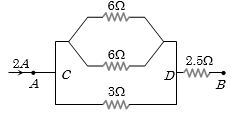
- 7The equivalent resistance and potential difference between $A$ and $B$ for the circuit is respectivelyView Solution
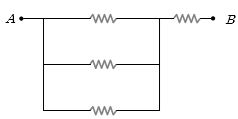
- 8If all the resistors shown have the value $2\, ohm$ each, the equivalent resistance over $AB$ isView Solution
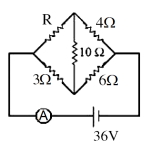
- 9Current measured by the ammeter $(A)$ in the reported circuit when no current flows through $10\,\Omega$ resistance. will be________$A$View Solution
- 10The resistances of a wire at temperatures $t\,^oC$ and $0\,^oC$ are related byView Solution