Question
For a particle in a uniformly accelerated circular motion

Answer

For a uniformly accelerated motion there are two acceleration, one along the radius called radial acceleration and another along tangent called tangential acceleration. Velocity is directed along the tangent

Need a full question paper?

Generate a complete, print-ready paper with questions like this in minutes — across 16+ boards, with answer keys.
Start Generating Free

Similar questions

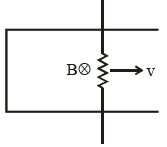
A conducting bar is pulled with a constant speed $v$ on a smooth conducting rail. The region has a steady magnetic field of induction $B$ as shown in the figure. If the speed of the bar is doubled then the rate of heat dissipation will
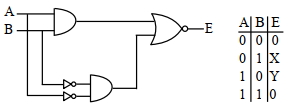
In the truth table of the above circuit the value of $X$ and $\mathrm{Y}$ are
Forty electric bulbs are connected in series across a $220\, V$ supply. After one bulb is fused, the remaining $39$ are connected again in series across the same supply. The illumination will be
Photo-electric effect can be explained by
A storage battery is connected to a charger for charging with a voltage of $12.5\,\,Volts$. The internal resistance of the storage battery is $1\,\,\Omega$ . When the charging current is $0.5\,\,A$, the emf of the storage battery is: ............... $volts$
A wavelength $0.60 cm$ is produced in air and it travels at a speed of $300 ms^{-1}$. It will be an
A particle of unit mass undergoes one­ dimensional motion such that its velocity varies according to $ v(x)= \beta {x^{ - 2n}}$, where $\beta$ and $n$ are constants and $x$ is the position of the particle. The acceleration of the particle as a function of $x$, is given by
Two soap bubbles of radii $2 \,cm$ and $4 \,cm$ join to form a double bubble in air, then radius of curvature of interface is .......... $cm$
A $500 \,kg$ car takes a round turn of radius $50 \,m$ with a velocity of $36 \,km/hr$. The centripetal force is ..........  $N$
If a skater of weight $3 \,kg$ has initial speed $32\, m/s$ and second one of weight $4 \,kg$ has $5 \,m/s$. After collision, they have speed (couple) $5\, m/s$. Then the loss in K.E. is