MCQ
For a particle in circular motion the centripetal acceleration is
  • A
    Less than its tangential acceleration
  • B
    Equal to its tangential acceleration
  • C
    More than its tangential acceleration
  • May be more or less than its tangential acceleration

Answer

Correct option: D.
May be more or less than its tangential acceleration
d
(d)There is no relation between centripetal and tangential acceleration. Centripetal acceleration is must for circular motion but tangential acceleration may be zero.

Need a full question paper?

Generate a complete, print-ready paper with questions like this in minutes — across 16+ boards, with answer keys.
Start Generating Free

Similar questions

A couple produces a:
Two solid rubber balls $A$ and $B$ having masses $200$ and $400\, gm$ respectively are moving in opposite directions with velocity of $A$ equal to $0.3 \,m/s$. After collision the two balls come to rest, then the velocity of $B$ is .............. $\mathrm{m} / \mathrm{s} $
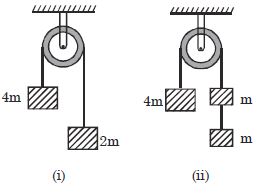
In the arrangement shown in figure, pulley is smooth and massles and all the strings are  light let $F_1$ be the force exerted on the pulley in case $(i)$ and $F_2$ the force in case $(ii)$. Then
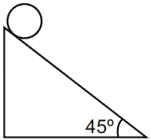
A disc of radius $20\, cm$ and mass half $kg$ is rolling on an inclined plane. Find out friction force so that disc performs pure rolling.
The spectrum of a black body at two temperatures $27\,^oC$ and $327\,^oC$ is shown in the figure. Let $A_1$ and $A_2$ be the areas under the two curves respectively. Find the value of $\frac {A_2}{A_1}$
Consider a thin square plate floating on a viscous liquid in a large tank. The height $h$ of the liquid in the tank is much less than the width of the tank. The floating plate is pulled horizontally with a constant velocity $u_0$. Which of the following statements is (are) true?

$(A)$ The resistive force of liquid on the plate is inversely proportional to $h$

$(B)$ The resistive force of liquid on the plate is independent of the area of the plate

$(C)$ The tangential (shear) stress on the floor of the tank increases with $u _0$

$(D)$ The tangential (shear) stress on the plate varies linearly with the viscosity $\eta$ of the liquid

A glass full of hot milk is poured on the table. It begins to cool gradually. Which of the following is correct?
  1. The rate of cooling is constant till milk attains the temperature of the surrounding.
  2. The temperature of milk falls off exponentially with time.
  3. While cooling, there is a flow of heat from milk to the surrounding as well as from surrounding to the milk but the net flow of heat is from milk to the surounding and that is why it cools.
  4. All three phenomenon, conduction, convection and radiation are responsible for the loss of heat from milk to the surroundings.
If electronic charge $e$, electron mass $m$, speed of light in vacuum $c$ and Planck 's constant $h$ are taken as fundamental quantities, the permeability of vacuum $\mu _0$ can be expressed in units of
At some temperature $T$, a bronze pin is a little large to fit into a hole drilled in a steel block. The change in temperature required for an exact fit is minimum when
During superposition of two waves of nearly equal frequencies, beats frequency is defined as the