MCQ
For a particle of a rotating rigid body, $\text{v}=\text{r}\omega,\text{So}$
  • A
    $\omega\propto(\frac{1}{\text{r}})$
  • B
    $\omega$ is independent of r.
  • C
    $\text{v }\propto\text{ r}$
  • C and D both

Answer

Correct option: D.
C and D both
Explanation:
As $\omega =\frac{2\pi}{\text{T}}$ constant, therefore, $\text{v }\propto\text{ r}$ Also, $\omega$ does not depend on r.

Need a full question paper?

Generate a complete, print-ready paper with questions like this in minutes — across 16+ boards, with answer keys.
Start Generating Free

Similar questions

A spinning wheel $A$ is brought in contact with another wheel $B,$ initially at rest. Because of the friction at contact, the second wheel also starts spinning. Which of the following energies of the wheel $B$ increases?
Which of the following quantities remain constant in a planetary motion (consider elliptical orbits) as seen from the sun?
When a gas in a closed vessel was heated so as to increase its temperature by ${5^o}C$, there occurred an increase of $1\%$ in its pressure. The original temperature of the gas was ...... $^oC$
A shell at rest on a smooth horizontal surface explodes into two fragments of masses $m_1$ and $m_2$. If just after explosion $m_1$ move with speed $u$, then work done by internal forces during explosion is
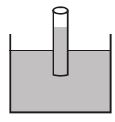
A long capillary tube of mass $'\pi '\,gm$ , radius $2\,mm$ and negligible thickness, is partially immersed in a liquid of surface tension $0.1\,N/m$ . Take angle of contact zero and neglect buoyant force of liquid. Find the force required to hold the tube vertically. $(g = 10\,m/s^2)$
$|\lambda\text{A}|=\lambda|\text{A}|,\ \text{if}$
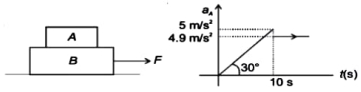
Acceleration of block $A$ varies with time as shown in figure the value of coefficient of kinetic friction between block $A$ and $B$ is the value of coefficient of kinetic friction between block $A$ and $B$ is .............. 
A train is moving at a constant speed $V$. When its driver observes another train in front of him on the same track and moving in the same direction with constant speed $u$. If the distance between the trains be $x$, then what should be the minimum retardation of the train so as to avoid collision?
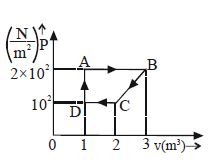
A cyclic process is shown in figure. Work done during isobaric expansion is ...... $J$
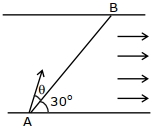
A swimmer wants to cross a river from point $A$ to point $B$. Line $A B$ makes an angle of $30^{\circ}$ with the flow of river. Magnitude of velocity of the swimmer is same as that of the river. The angle $\theta$ with the line ${AB}$ should be $^{\circ}$, so that the swimmer reaches point ${B}$.