MCQ
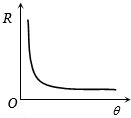
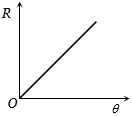
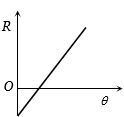
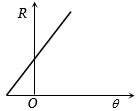
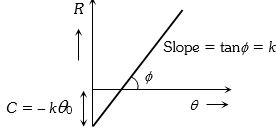
For a small temperature difference between the body and the surroundings the relation between the rate of loss heat $R$ and the temperature of the body is depicted by
  • A

  • B


  • D

Answer

Correct option: C.

c
(c) Rate of loss of heat $(R)$  $\propto$ temperature difference

==>$R \propto (\theta - {\theta _0})$

==>$R = \;k(\theta - {\theta _0}) = k\theta - k{\theta _0}$(k= constant)
on comparing it with $y = mx + c$ it is observed that, the graph between $R$ and $\theta$ will be straight line with slope $=k$ and intercept
Need a full question paper?

Generate a complete, print-ready paper with questions like this in minutes — across 16+ boards, with answer keys.
Start Generating Free

Similar questions

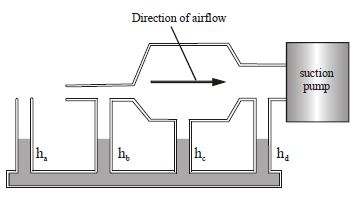
Rank in order, from highest to lowest, the liquid heights $h_a$ to $h_d$ .The air flow is from left to right. The liquid columns are not drawn to scale
Resolving power of a microscope depends upon
A sphere is suspended by a thread of length $l$. What minimum horizontal velocity has to be imparted the ball for it to reach the height of the suspension
The displacement of a particle varies according to the relation $x = 3 \sin 100 \, t + 8 \cos ^2 50\,t $. Which of the following is/are correct about this motion .
In a vessel of $21\, cm$ depth, upto what height the water should be filled so that now it appears to be $20\%$ filled if viewed from the top........$cm$ $(\mu_{water} - 4/3)$
The bulk modulus of rubber is $9.1\times 10^8\,N/m^2$. To ......... $m$ depth a rubber ball be taken in a lake so that its volume is decreased by $0.1\,\%$ .
Predict the product $‘B’$ in the sequence of reaction

 $HC \equiv CH\mathop {\xrightarrow{{30\%\, {H_2}S{O_4}}}}\limits_{HgS{O_4}} A\xrightarrow{{NaOH}}B$

A man fires a bullet of mass $200 \,g$ at a speed of $5 \,m/s$. The gun is of one $kg$ mass. by what velocity the gun rebounds backwards ........ $m/s$
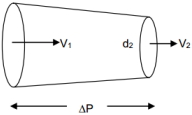
Determine the pressure difference in tube of non$-$uniform cross sectional area as shown in figure. $\Delta P =?$ (in $pa$)

$d_{1}=5\, cm , V_{1}=4\, cm , d_{2}=2\, cm , V_{2}=?$
A thin oil film of refractive index $1.2$ floats on the surface of water $(\mu = \frac{4}{3}).$ When a light of wavelength $\lambda = 9.6 \times 10^{-7}\ m$ falls normally on the film from air, then it appears dark when seen normally. The minimum change in its thickness for which it will appear bright in normally reflected light by the same light is :-