Question
For a surface molecule:
  1. The net force on it is zero.
  2. There is a net downward force.
  3. The potential energy is less than that of a molecule inside.
  4. The potential energy is more than that of a molecule inside.
Answer

  1. There is a net downward force.
  1. The potential energy is more than that of a molecule inside.
Explanation:

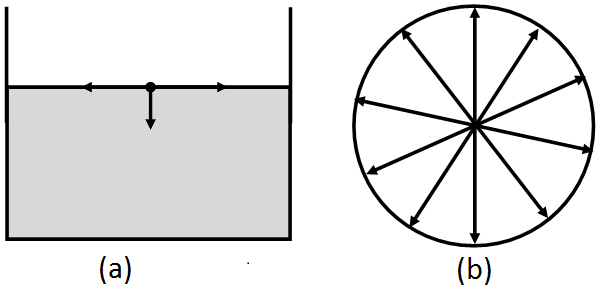
A molecule viewed from the top to surface of the fluid. Force exerted on a molecule by all nearby molecule are equal and opposite, so net horizontal component of force is zero. as a molecule is viewed horizontally to the surface of fluid a vertically downward force acts on molecule due to which it does not escape from surface.

There is a net attractive force on molecules at surface acting downwards. So the P.E of molecules at the surface is negative to lower ones but in magnitude PE(mgh) is more than that of the lower or inside molecules.

Need a full question paper?

Generate a complete, print-ready paper with questions like this in minutes — across 16+ boards, with answer keys.

Start Generating Free

Similar questions

The magnitude of pairs of displacement vectors are given. Which pair of displacement  vectors cannot be added to give a resultant vector of magnitude $13\, cm$?
A policeman on duty detects a drop of $10 \%$ in the pitch of the hom of motion of car as it crosses him. If the velocity of sound is $330 \,m / s$. Calculate the speed of the car ........... $m / s$
If momentum $(P),$ area $(A)$ and time $(T)$ are taken to be the fundamental quantities then the dimensional formula for energy is :
The kinetic energy of one gm-mole of a gas at normal temperature and pressure is $(R = 8.31 J/Mole-K)$
A particle starting from rest, moves in a circle of radius $r$. It attains a velocity of $\mathrm{V}_{0} \;\mathrm{m} / \mathrm{s}$ in the $\mathrm{n}^{\text {th }}$ round. Its angular acceleration will be
A body $x$ with a momentum $p$ collides with another identical stationary body $y$ one dimensionally. During the collision $y$ gives an impulse $J$ to body $x$. Then coefficient of restitution is
Two bodies, a ring and a solid cylinder of same material are rolling down without slipping an inclined plane. The radii of the bodies are same. The ratio of velocity of the centre of mass at the bottom of the inclined plane of the ring to that of the cylinder is $\frac{\sqrt{x}}{2}$. Then, the value of $x$ is .... .
A projectile is thrown with velocity $v$ at an angle $\theta$ with horizontal. When the projectile is at a height equal to half of the maximum height, the vertical component of the velocity of projectile is ...........
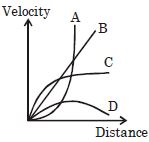
A small spherical solid ball is dropped in a viscous liquid. Its journey in the liquid is best  described in the figure drawn by:-
Two particles A and B have a phase difference of $\pi$ when a sine wave passes through the region.
  1. A oscillates at half the frequency of B.
  2. A and B move in opposite directions.
  3. A and B must be separated by half of the wavelength.
  4. The displacements at A and B have equal magnitudes.