MCQ
Two bodies, a ring and a solid cylinder of same material are rolling down without slipping an inclined plane. The radii of the bodies are same. The ratio of velocity of the centre of mass at the bottom of the inclined plane of the ring to that of the cylinder is $\frac{\sqrt{x}}{2}$. Then, the value of $x$ is .... .
  • A
    $1$
  • $3$
  • C
    $9$
  • D
    $10$

Answer

Correct option: B.
$3$
b
${I}$ in both cases is about point of contact $IAOR,$

Ring,

$m g h=\frac{1}{2} I \omega^{2}$

$m g h=\frac{1}{2}\left(2 m R^{2}\right) \frac{v_{R}^{2}}{R^{2}}$

$V_{R}=\sqrt{g h}$

Solid, cylinder

$m g h=\frac{1}{2} I \omega^{2}$

$m g h=\frac{1}{2}\left(\frac{3}{2} m R^{2}\right) \frac{v_{c}^{2}}{R^{2}}$

$V_{R}=\sqrt{\frac{4 g h}{3}}$

$\frac{v_{R}}{v_{c}}=\frac{\sqrt{3}}{2}$

Need a full question paper?

Generate a complete, print-ready paper with questions like this in minutes — across 16+ boards, with answer keys.

Start Generating Free

Similar questions

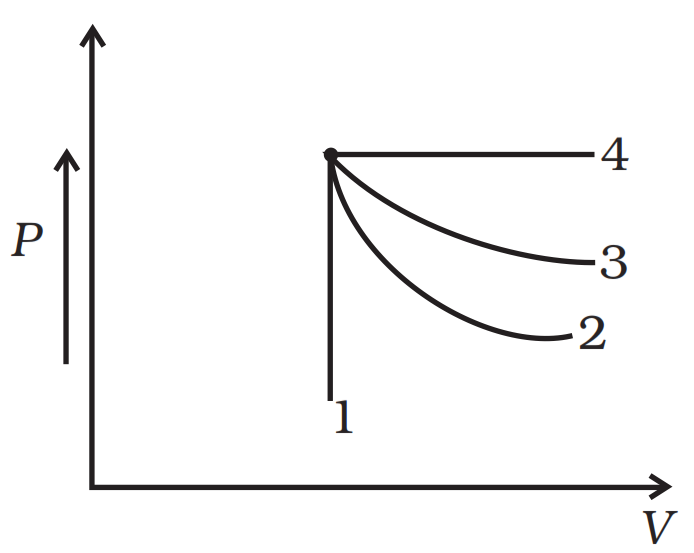
An ideal gas undergoes four different processes from thesame initial state (Fig.). Four processes are adiabatic, isothermal, isobaric and isochoric. Out of 1, 2, 3 and 4 whichone is adiabatic.

  1. 4
  2. 3
  3. 2
  4. 1
A body of mass $m$ is projected at an angle of ${45^o}$ with the horizontal. If air resistance is negligible, then total change in momentum when it strikes the ground is
The pressure of a molecular gas at constant volume depends on:
A simple pendulum has a time period ${T_1}$ when on the earth’s surface and ${T_2}$ when taken to a height $R$ above the earth’s surface, where $R$ is the radius of the earth. The value of ${T_2}/{T_1}$ is
A wagon of $200\, kg$ is moving on a smooth track with a velocity of $2\, m/s$. A man of $80\, kg$ also runs in the wagon with a velocity such that the speed of centre of mass of the system is zero. Find the relative velocity of man w.r.t. wagon ...... $m/s$
Snow is more heat insulating than ice, because
A batsman deflects a ball by an angle of $45^o$ without changing its initial speed which is equal to $54\; km/h$. What is the impulse imparted to the ball in $kg\;m/s$? (Mass of the ball is $0.15 \;kg.)$
Pressure is a scalar quantity because:
  1. it is the ratio of force to area and both force and area are vectors.
  2. It is the ratio of the magnitude of the force to area.
  3. It is the ratio of the component of the force normal to the area.
  4. It does not depend on the size of the area chosen.
A particle gets displaced by $\Delta \,\vec r = \,(2\hat i + 3\hat j + 4\hat k)$ $m$ under the action of a force $\vec F = \,(7\hat i + 4\hat j + 3\hat k)$ The change in its kinetic energy is ............... $\mathrm{J}$
The principle of ‘parallax’  is used in the determination of distances of very distant stars. The baseline $AB$ is the line joining the Earth’s two locations six months apart in its orbit around the Sun. That is, the baseline is about the diameter of the Earth’s orbit $\approx 3 \times 10^{11}\;m$. However, even the nearest stars are so distant that with such a long baseline, they show parallax only of the order of $1”$ (second) of arc or so. A parsec is a convenient unit of length on the astronomical scale. It is the distance of an object that will show a parallax of $1”$ (second of arc) from opposite ends of a baseline equal to the distance from the Earth to the Sun. How much is a parsec in terms of metres ?