MCQ
For adiabatic processes $\left( {\gamma = \frac{{{C_p}}}{{{C_v}}}} \right)$
  • A
    ${P^\gamma }V$ = constant
  • B
    ${T^\gamma }V$= constant
  • $T{V^{\gamma - 1}}$ =constant
  • D
    $T{V^\gamma }$ = constant

Answer

Correct option: C.
$T{V^{\gamma - 1}}$ =constant
c
(c)In adiabatic process $P{V^\gamma } = $constant
==> $\left( {\frac{{RT}}{V}} \right).{V^\gamma } = $constant ==> $T{V^{\gamma - 1}}$= constant

Need a full question paper?

Generate a complete, print-ready paper with questions like this in minutes — across 16+ boards, with answer keys.

Start Generating Free

Similar questions

Two pendulum have time periods $T$ and $5T/4$. They start $SHM$ at the same time from the mean position. After how many oscillations of the smaller pendulum they will be again in the same phase
Consider two containers $A$ and $B$ containing monoatomic gases at the same Pressure $(P)$, Volume $(V)$ and Temperature $(T)$. The gas in $A$ is compressed isothermally to $\frac{1}{8}$ of its original volume while the gas $B$ is compressed adiabatically to $\frac{1}{8}$ of its original volume. The ratio of final pressure of gas in $B$ to that of gas in $A$ is ...........
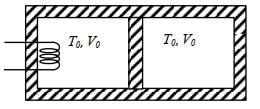
A thermally insulating cylinder has a thermally insulating and frictionless movable partition in the middle, as shown in the figure below. On each side of the partition, there is one mole of an ideal gas, with specific heat at constant volume, $C_v=2 R$. Here, $R$ is the gas constant. Initially, each side has a volume $V_0$ and temperature $T_0$. The left side has an electric heater, which is turned on at very low power to transfer heat $Q$ to the gas on the left side. As a result the partition moves slowly towards the right reducing the right side volume to $V_0 / 2$. Consequently, the gas temperatures on the left and the right sides become $T_L$ and $T_R$, respectively. Ignore the changes in the temperatures of the cylinder, heater and the partition.

($1$) The value of $\frac{T_R}{T_0}$ is

$(A)$ $\sqrt{2}$ $(B)$ $\sqrt{3}$ $(C)$ $2$ $(D)$ $3$

($2$) The value of $\frac{Q}{R T_0}$ is

$(A)$ $4(2 \sqrt{2}+1)$ $(B)$ $4(2 \sqrt{2}-1)$ $(C)$ $(5 \sqrt{2}+1)$ $(D)$ $(5 \sqrt{2}-1)$

Give the answer or qution ($1$) and ($2$)
Let the moment of inertia of a hollow cylinder of length $30\, cm$ (inner radius $10\, cm$ and outer radius $20\, cm$), about its axis be $I$. The radius of a thin cylinder of the same mass such that its moment of inertia about its axis is also $I$, is ......... $cm$.
Two discs of moment of inertia $I_1=4 \mathrm{~kg} \mathrm{~m}^2$ and $\mathrm{I}_2=2 \mathrm{~kg} \mathrm{~m}^2$ about their central axes & normal to their planes, rotating with angular speeds $10 \mathrm\ {rad} / \mathrm{s}$ & $4  \mathrm\ {rad} / \mathrm{s}$ respectively are brought into contact face to face with their axe of rotation coincident. The loss in kinetic energy of the system in the process is____ $\mathrm{J}$.
A planet of mass is moving around a star of mass $M$ and radius $R$ in a circular orbit of radius $r$. The star abruptly shrinks to half its radius without any loss of mass. What change will be there in the orbit of the planet?
A projectile projected at an angle ${30^o}$ from the horizontal has a range $2\upsilon ,\,\sqrt 2 \upsilon \,\,{\rm{ and}}\,{\rm{zero}}$. If the angle of projection at the same initial velocity be ${60^o}$, then the range will be
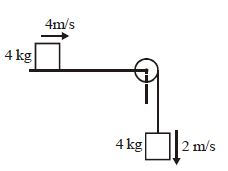
Two blocks of same mass $(4\ kg)$ are placed according to diagram. Initial velocities of bodies are $4\ m/s$ and $2\ m/s$ and the string is taut. Find the impulse on $4\ kg$ when the string again becomes taut  .......... $N-s$
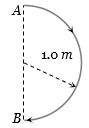
In $1.0\, s$ a particle goes from point $A$ to point $B$, moving in a semicircle of radius $1.0\, m$ (see figure). The magnitude of the average velocity is ......... $m/s$
A particle is projected from horizontal making an angle of $53^{\circ}$ with initial velocity $100\,m / s$. The time taken by the particle to make angle $45^{\circ}$ from horizontal is $.........\,s$