MCQ
For an ideal gas, in an isothermal process
  • A
    Heat content remains constant
  • B
    Heat content and temperature remain constant
  • Temperature remains constant
  • D
    None of the above

Answer

Correct option: C.
Temperature remains constant
(c) In isothermal process temperature remains constant.

Need a full question paper?

Generate a complete, print-ready paper with questions like this in minutes — across 16+ boards, with answer keys.
Start Generating Free

Similar questions

A batsman hits a sixer and the ball touches the ground outside the cricket ground. Which of the following graph describes the variation of the cricket ball's vertical velocity $v$ with time between the time $t_1$ as it hits the bat and time $t$ when it touches the ground
The current in a coil changes from 4 ampere to zero in $0.1 \mathrm{~s}$. If the average e.m.f. induced is $100 \mathrm{volt}$, what is the self inductance of the coil
A metallic block of density $5 gm cm$ and having dimensions $5 cm \times$ $5 cm \times 5 cm$ is weighed in water. Its apparent weight will be
If a shell fired from a cannon, explodes in mid air, then
Two sound waves of slightly different frequencies propagating in the same direction produce beats due to
The critical angle between an equilateral prism and air is $45^{\circ}$. If the incident ray is perpendicular to the refracting surface, then
In the non-resonant circuit, what will be the nature of the circuit for frequencies higher than the resonant frequency
A planet revolves around sun whose mean distance is $1.588$ times the mean distance between earth and sun. The revolution time of planet will be
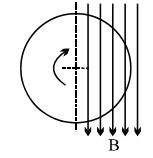
A thin non conducting disc of radius $R$ is rotating clockwise (see figure) with an angular velocity $w$ about its central axis, which is perpendicular to its plane. Both its surfaces carry $+ve$ charges of uniform surface density. Half the disc is in a region of a uniform, unidirectional magnetic field $B$ parallel to the plane of the disc, as shown. Then,
Two cylinders $A$ and $B$ fitted with pistons contain equal amounts of an ideal diatomic gas at $300 \mathrm{~K}$. The piston of $A$ is free to move while that of $B$ is held fixed. The same amount of heat is given to the gas in each cylinder. If the rise in temperature of the gas in $A$ is $30 \mathrm{~K}$, then the rise in temperature of the gas in $B$ is