For any $S.H.M.$, amplitude is $6\, cm$. If instantaneous potential energy is half the total energy then distance of particle from its mean position is .... $cm$
Easy
Download our app for free and get started
(b) If at any instant displacement is $y$ then it is given that $U = \frac{1}{2} \times E$ ==> $\frac{1}{2}m{\omega ^2}{y^2} = \frac{1}{2} \times \left( {\frac{1}{2}m{\omega ^2}{a^2}} \right)$
==> $y = \frac{a}{{\sqrt 2 }} = \frac{6}{{\sqrt 2 }} = 4.2\,cm$
==> $y = \frac{a}{{\sqrt 2 }} = \frac{6}{{\sqrt 2 }} = 4.2\,cm$

Download our appand get started for free
Experience the future of education. Simply download our apps or reach out to us for more information. Let's shape the future of learning together!No signup needed.*
Similar Questions
- 1View SolutionWhat is constant in S.H.M.
- 2The kinetic energy and potential energy of a particle executing simple harmonic motion will be equal, when displacement (amplitude = $a$) isView Solution
- 3A block of mass $1 \,kg$ attached to a spring is made to oscillate with an initial amplitude of $12\, cm$. After $2\, minutes$ the amplitude decreases to $6\, cm$. Determine the value of the damping constant for this motion. (take In $2=0.693$ )View Solution
- 4If a spring extends by $x$ on loading, then energy stored by the spring is (if $T$ is the tension in the spring and $K$ is the spring constant)View Solution
- 5A circular disc of mass $10 \;kg$ is suspended by a wire attached to its centre. The wire is twisted by rotating the disc and released. The period of torsional oscillations is found to be $1.5 \;s$. The radius of the disc is $15\; cm .$ Determine the torsional spring constant of the wire in $N\;m\;rad^{-1}$. (Torsional spring constant $\alpha$ is defined by the relation $J=-\alpha \theta,$ where $J$ is the restoring couple and $\theta$ the angle of twist).View Solution
- 6The variations of potential energy $(U)$ with position $x$ for three simple harmonic oscillators $A, B$ and $C$ are shown in figure. The oscillators have same mass. The time period of oscillation is greatest forView Solution
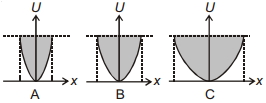
- 7A simple pendulum is suspended in a car. The car starts moving on a horizontal road according to equation $x\, = \,\frac{g}{2}\,\sqrt 3 {t^2}$. Find the time period of oscillation of the pendulum.View Solution
- 8The periodic time of a body executing simple harmonic motion is $3\, sec$. After how much interval from time $t = 0$, its displacement will be half of its amplitude ..... $\sec$View Solution
- 9In a seconds pendulum, mass of bob is $30\, gm$. If it is replaced by $90\, gm$ mass. Then its time period will .... $\sec$View Solution
- 10If displacement $x$ and velocity $v$ are related as $4v^2 = 16\, -\, x^2$ in a $SHM$ . Then time period of given $SHM$ is (consider $SI\,units$ )View Solution