Question
For effective nuclear forces, the distance should be

Answer

Nuctear force is powek fully attractive b/w nucleons at a destance of about $1$ $Fenttometre$ ( $\left.1 \times 10^{-15} \,m \right)$

Need a full question paper?

Generate a complete, print-ready paper with questions like this in minutes — across 16+ boards, with answer keys.
Start Generating Free

Similar questions

The ${K_\alpha }$ $X$ - rays arising from a cobalt $(z = 27)$ target have a wavelength of $179\, pm$. The ${K_\alpha }$ $X$ - rays arising from a nickel target $(z = 28)$ is
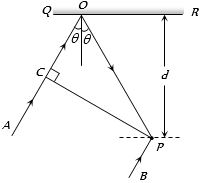
In the adjacent diagram,$ CP$ represents a wavefront and $AO$ & $BP$, the corresponding two rays. Find the condition on $\theta$ for constructive interference at $P$ between the ray $BP$ and reflected ray $OP$
A disc of radius $R$ and thickness $\frac {R}{6}$ has moment of inertia $I$ about an axis passing through its centre and perpendicular to its plane. Disc is melted and recast into a solid sphere. The moment of inertia of a sphere about its diameter is
Two satellite $A$ and $B$, ratio of masses $3 : 1$ are in circular orbits of radii $r$ and $4r$. Then ratio of total mechanical energy of $ A$ to $B$ is
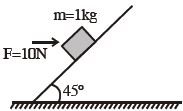
A body of mass $1\, kg$ lies on smooth inclined plane. The body is given force $F = 10N$  horizontally as shown. The magnitude of net normal reaction on the body is 
A parallel plate capacitor has circular plates of $0.08\,m$ radius and $1.0 \times {10^{ - 3}}\,m$ separation. If a $P.D.$ of $100\;volt$ is applied, the charge will be
$A$ force exerts an impulse $I$ on a particle changing its speed from $u$ to $2u$. The applied force and the initial velocity are oppositely directed along the same line. The work done by the force is
For an adiabatic expansion of an ideal gas, the fractional change in its pressure is equal to (where $\gamma$ is the ratio of specific heats):
An ideal gas at atmospheric pressure is adiabatically compressed so that its density becomes $32$ times of its initial value. If the final pressure of gas is $128$ atmosphers, the value of $\gamma$ the gas is
A series $LCR$ circuit is subjected to an $AC$ signal of $200 \mathrm{~V}, 50 \mathrm{~Hz}$. If the voltage across the inductor $(\mathrm{L}=10 \mathrm{mH})$ is $31.4 \mathrm{~V}$, then the current in this circuit is $\qquad$