MCQ
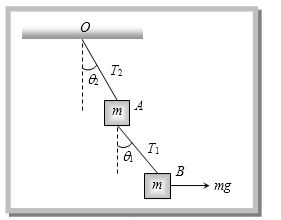
For given systen ${\theta _2}$ ....... $^o$ 
  • A
    $30^o$
  • B
    $45^o$
  • C
    $60^o$
  • ${\tan ^{ - 1}}\left( {\frac{1}{2}} \right)$

Answer

Correct option: D.
${\tan ^{ - 1}}\left( {\frac{1}{2}} \right)$
d
$\frac{{\sin {\theta _2}}}{{\cos {\theta _2}}} = \frac{{mg}}{{2mg}}$$ \Rightarrow $ $\tan {\theta _2} = \frac{1}{2}$

$\therefore {\theta _2} = {\tan ^{ - 1}}\left[ {\frac{1}{2}} \right]$

Need a full question paper?

Generate a complete, print-ready paper with questions like this in minutes — across 16+ boards, with answer keys.
Start Generating Free

Similar questions

When a body moves with some friction on a surface
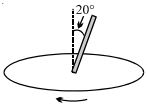
$A$ uniform rod is fixed to a rotating turntable so that its lower end is on the axis of the turntable and it makes an angle of $20^o$ to the vertical. (The rod is thus rotating with uniform angular velocity about a vertical axis passing through one end.) If the turntable is rotating clockwise as seen from above. What is the direction of the rod's angular momentum vector (calculated about its lower end)?
Two men are carrying a uniform bar of length $L$, on their shoulders. The bar is held horizontally such that younger man gets $(1/4)^{th}$ load. Suppose the younger man is at the end of the bar, what is the distance of the other man from the end
Absorption co-efficient of an open window is...
 A rod of length l rotates with a small but uniform angular velocity $\omega$ about its perpendicular bisector. A uniform magnetic field B exists parallel to the axis of rotation. The potential difference between the centre of the rod and an end is:

  1. $\text{zero}$

  2. $\frac{1}{8}\omega\text{Bl}^2$

  3. $\frac{1}{2}\omega\text{Bl}^2$

  4. $\text{B}\omega\text{l}^2$ 

The potential energy of a simple harmonic oscillator when the particle is half way to its end point is (where $E$ is the total energy)
A particle is projected with a velocity of $30\,m / s$, at an angle of $\theta_0=\tan ^{-1}\left(\frac{3}{4}\right)$ After $1\,s$, the particle is moving at an angle $\theta$ to the horizontal, where $\tan \theta$ will be equal to $\left(g=10\,m / s ^2\right)$
What is the change in temperature on Fahrenheit scale and Kelvin scale, if an iron piece is heated from $30\ ^oC$ to $90\ ^oC$?
A rocket is fired vertically frorn the earth with an acceleration of  $2\,g,$  where $g$  is the gravitational acceleration. On an inclined plane inside the rocket, making an angle $\theta $ with the horizontal, a point object of mass $m$ is kept. The minimum coefficient of friction $\mu _{min}$  between the mass and the inclined surface such that the mass does not move is
$A$ pulley is hinged at the centre and a massless thread is wrapped around it. The thread is pulled with a constant force $F$ starting from rest. As the time increases,