Question
For given $\vec E = 2x\hat i + 3y\hat j$, find the potential at $(X, Y)$ if potential at origin is $5\, volts.$

Answer

$\int_{5}^{\mathrm{V}} \mathrm{dV}=-\int_{(0,0)}^{(\mathrm{X} , \mathrm{Y})} \mathrm{E} \cdot \mathrm{dr}=-\int_{0}^{\mathrm{X}} \mathrm{E}_{\mathrm{X}} \cdot \mathrm{dx}-\int_{0}^{\mathrm{Y}} \mathrm{E}_{\mathrm{Y}} \mathrm{dy}$

$V-5=\frac{-2 X^{2}}{2} \frac{-3 Y^{2}}{2}$

$V=\frac{-2 X^{2}}{2} \frac{-3 Y^{2}}{2}+5$

Need a full question paper?

Generate a complete, print-ready paper with questions like this in minutes — across 16+ boards, with answer keys.

Start Generating Free

Similar questions

Benzaldehyde can be formed by :-
An object is projected vertically up from the earth's surface with velocity $\sqrt {Rg}$ where $R$ is the radius of the earth and $'g'$ is the acceleration due to earth on the  surface of earth. Find the maximum height reached by the object.
A diminished image of an object is to be obtained on a screen $1.0 m$ from it. This can be achieved by appropriately placing
If solid will break under pressure greater than $13\  atm$ and that solid has a specific gravity of $4$ , what is the maximum height of a cylinder made from the solid that can be built at the earth's surface ? (Note: $1\ atm$ = $10^5\  Pa$ .) ......... $m$
If a charged spherical conductor of radius $10\,cm$ has potential $V$ at a point distant $5\,cm$ from its centre, then the potential at a point distant $15\,cm$ from the centre will be
A proton is accelerated through $50,000\, V$. Its energy will increase by
$A$ block of mass $m$ moving with a velocity $v_0$ on a smooth horizontal surface strikes and compresses a spring of stiffness $k$ till mass comes to rest as shown in the figure. This phenomenon is observed by two observers:

$A$: standing on the horizontal surface

$B$: standing on the block 

According to observer $B$, the potential energy of the spring increases

If $v$ is the velocity of a body moving along $x$-axis, then acceleration of body is .........
Three concentric metallic spherical shells of radii $R, 2R, 3R$, are given charges $Q_1, Q_2, Q_3$, respectively. It is found that the surface charge densities on the outer surfaces of the shells are equal. Then, the ratio of the charges given to the shells, $Q_1 : Q_2 : Q_3$ is
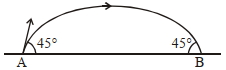
The projectile motion of a particle of mass $5\, g$ is shown in the figure.

The initial velocity of the particle is $5 \sqrt{2}\, ms ^{-1}$ and the air resistance is assumed to be negligible. The magnitude of the change in momentum between the points $A$ and $B$ is $x \times 10^{-2}\, kgms ^{-1} .$ The value of $x ,$ to the nearest integer, is ...... .