If a charged spherical conductor of radius $10\,cm$ has potential $V$ at a point distant $5\,cm$ from its centre, then the potential at a point distant $15\,cm$ from the centre will be
Easy


Download our appand get started for free
Experience the future of education. Simply download our apps or reach out to us for more information. Let's shape the future of learning together!No signup needed.*
Similar Questions
- 1The potential at a point $x$ (measured in $μ\ m$) due to some charges situated on the $ x$-axis is given by $V(x)$ =$\frac{{20}}{{{x^2} - 4}}$ $volt$ The electric field $E$ at $x = 4\ μ m$ is given byView Solution
- 2View SolutionIf a charge is shifted from a low potential region to high potential region, the electric potential energy
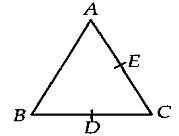
- 3Three charges, each $+q,$ are placed at the comers of an isosceles triangle $ABC$ of sides $BC$ and $AC, 2a.$ $D$ and $E$ are the mid-points of $BC$ and $CA.$ The work done in taking a charge $Q$ from $D$ to $E$ isView Solution
- 4For a charged spherical ball, electrostatic potential inside the ball varies with $r$ as $V =2 ar ^2+ b$. Here, $a$ and $b$ are constant and $r$ is the distance from the center. The volume charge density inside the ball is $-\lambda a \varepsilon$. The value of $\lambda$ is $...........$. $\varepsilon=$ permittivity of medium.View Solution
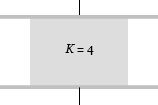
- 5Consider a parallel plate capacitor of $10\,\mu \,F$ (micro-farad) with air filled in the gap between the plates. Now one half of the space between the plates is filled with a dielectric of dielectric constant $4$, as shown in the figure. The capacity of the capacitor changes to.......$\mu \,F$View Solution
- 6In free space, a particle $A$ of charge $1\,\mu C$ is held fixed at a point $P.$ Another particle $B$ of the same charge and mass $4\,\mu g$ is kept at a distance of $1\,mm$ from $P$. If $B$ is released, then its velocity at a distance of $9\,mm$ from $P$ is [ Take $\frac{1}{{4\pi {\varepsilon _0}}} = 9 \times {10^9}\,N{m^2}{C^{ - 2}}$ ]View Solution
- 7If there are $n$ capacitors in parallel connected to $V$ volt source, then the energy stored is equal toView Solution
- 8A capacitor having capacitance $C$ is charged to a voltage $V$. It is then removed and connected in parallel with another identical capacitor which is uncharged. The new charge on each capacitor is nowView Solution
- 9View SolutionThe energy stored in a condenser is in the form of
- 10A capacitor is half filled with a dielectric $(K=2)$ as shown in figure A. If the same capacitor is to be filled with same dielectric as shown, what would be the thickness of dielectric so that capacitor still has same capacity?View Solution