MCQ
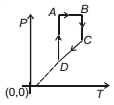
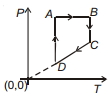
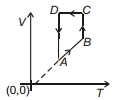
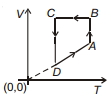
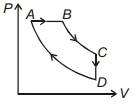
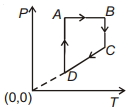
For $P-V$ diagram of a thermodynamic cycle as shown in figure, process $B C$ and $D A$ are isothermal. Which of the corresponding graphs is correct?
  • A


  • C

  • D

Answer

Correct option: B.

b
(b)

From $A \longrightarrow B$, volume increasing, pressure constant

$B \longrightarrow C$, Pressure $\propto \frac{1}{\text { Volume }} \Rightarrow$ Temperature constant

Same for $D \longrightarrow A$

$C \longrightarrow D$ pressure decreasing, volume constant

So $P \propto T$
Need a full question paper?

Generate a complete, print-ready paper with questions like this in minutes — across 16+ boards, with answer keys.
Start Generating Free

Similar questions

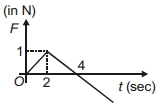
Force acting on a body varies with time as shown below. If initial momentum of the body is $\vec{p}$, then the time taken by the body to retain its momentum $\vec{p}$ again is ........... $s$
In Searle's method for finding conductivity of metals, the temperature gradient along the bar
What is the minimum energy required to launch a satellite of mass $m$ from the surface of a planet of mass $M$ and radius $R$ in a circular orbit at an altitute of $2R$ ?
What is the distance of the centre of mass of a half ring from its centre if its radius is 0.5 m?
In a capillary tube, water rises to $3\, mm$. The height of water that will rise in another capillary tube having one-third radius of the first is ........ $mm$
A ball is thrown upwards and it returns to ground describing a parabolic path. Which of the following remains constant
A wire of length $L$ is hanging from a fixed support. The length changes to $L _{1}$ and $L _{2}$ when masses $1 \,kg$ and $2 \,kg$ are suspended respectively from its free end. Then the value of $L$ is equal to ..................
One end of a string of length $L$ is tied to the ceiling of a lift accelerating upwards with an acceleration $2g$. The other end of the string is free. The linear mass density of the string varies linearly from $0$ to $\lambda$ from bottom to top.
A car is going round a circle of radius $R_1$ with constant speed. Another car is going round a circle of radius $R_2$ with constant speed. If both of them take same time to complete the circles, the ratio of their angular speeds and linear speeds will be .........
If the frequency of an object in uniform circular motion is doubled, its acceleration becomes