Question
For question two statements are given-one labelled Assertion (A) and the other labelled Reason (R). Select the correct answer to these questions from the codes (a), (b), (c) and (d) as given below:
  1. Both A and R are true, and R is correct explanation of the assertion.
  2. Both A and R are true, but R is not the correct explanation of the assertion.
  3. A is true, but R is false.
  4. A is false, but R is true.
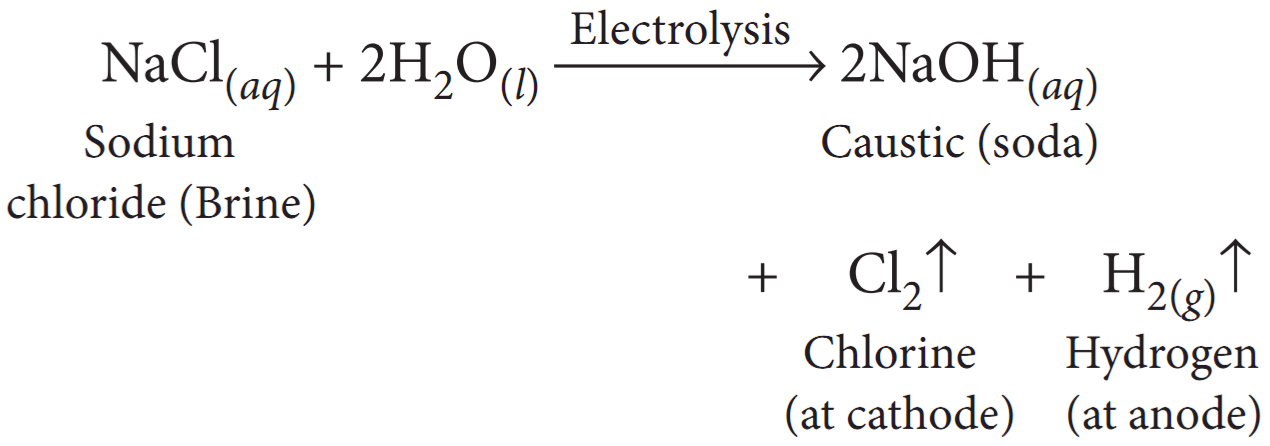
Assertion: Baking soda is prepared by chlor-alkali process.
Reason: Brine decomposes to sodium hydroxide on passing electricity through it.
Need a full question paper?

Generate a complete, print-ready paper with questions like this in minutes — across 16+ boards, with answer keys.

Start Generating Free

Similar questions

For two statements are given-one labelled Assertion (A) and the other labelled Reason (R). Select the correct answer to these questions from the codes (a), (b), (c) and (d) as given below:
  1. Both A and R are true, and R is correct explanation of the assertion.
  2. Both A and R are true, but R is not the correct explanation of the assertion.
  3. A is true, but R is false.
  4. A is false, but R is true.
Assertion: MgO exists in liquid state.
Reason: The electrostatic forces of attraction between Mg2+ and O2- ions constitute ionic bond.
Assertion (A): The balancing of chemical equations is based on the law of conservation of mass.
Reason (R): Total mass of reactants is equal to the total mass of products.
The following questions, a statement of Assertion is given by the corresponding statement of Reason. Of the statements, mark the correct answer as.
  1. If both Assertion and Reason are true and Reason is the correct explanation of Assertion.
  2. If both Assertion and Reason are true, but Reason is not the correct explanation of Assertion.
  3. If Assertion is true, but Reason is false.
  4. If Assertion is false, but Reason is true.
Assertion Alcohol cannot be used as an additive in petrol.
Reason Alcohol give rise to CO and H2O when burnt in sufficient air.
For question two statements are given- one labelled Assertion (A) and the other labelled Reason (R). Select the correct answer to these questions from the codes (a), (b), (c) and (d) as given below:
  1. Both A and R are true, and R is correct explanation of the assertion.
  2. Both A and R are true, but R is not the correct explanation of the assertion.
  3. A is true, but R is false.
  4. A is false, but R is true.
Assertion: Graphite is soft and slippery to touch.

Reason: Graphite has sheet like layered structure.
For two statements are given-one labelled Assertion (A) and the other labelled Reason (R). Select the correct answer to these questions from the codes (a), (b), (c) and (d) as given below:
  1. Both A and R are true, and R is correct explanation of the assertion.
  2. Both A and R are true, but R is not the correct explanation of the assertion.
  3. A is true, but R is false.
  4. A is false, but R is true.
Assertion: ln the reaction, $\text{Zn}_\text{(s)}+ 2\text{H}^+_{\text{(aq)}}\rightarrow\text{Zn}^{2+}_{\text{(aq)}} + \text{H}_{2_\text{(g)}}$ zinc acts as an oxidising agent and H+ acts as a reducing agent.
Reason: An oxidising agent accepts electrons while a reducing agent loses electrons.
For question two statements are given- one labelled Assertion (A) and the other labelled Reason (R). Select the correct answer to these questions from the codes (a), (b), (c) and (d) as given below:
  1. Both A and R are true, and R is correct explanation of the assertion.
  2. Both A and R are true, but R is not the correct explanation of the assertion.
  3. A is true, but R is false.
  4. A is false, but R is true.
Assertion: Carbon and its compounds can be used as fuels.

Reason: They are highly inflammable and have high calorific value.
For two statements are given-one labelled Assertion (A) and the other labelled Reason (R). Select the correct answer to these questions from the codes (a), (b), (c) and (d) as given below:
  1. Both A and R are true, and R is correct explanation of the assertion.
  2. Both A and R are true, but R is not the correct explanation of the assertion.
  3. A is true, but R is false.
  4. A is false, but R is true.
Assertion: Non-metals are electronegative in nature.
Reason: They have tendency to lose electrons.
Assertion (A) : While dissolving an acid or base in water, the acids must always be added slowly to water with constant stirring.
Reason (R) : Dissolving an acid on a base in water is a highly exothermic reaction.
For question two statements are given-one labelled Assertion (A) and the other labelled Reason (R). Select the correct answer to these questions from the codes (a), (b), (c) and (d) as given below:
  1. Both A and R are true, and R is correct explanation of the assertion.
  2. Both A and R are true, but R is not the correct explanation of the assertion.
  3. A is true, but R is false.
  4. A is false, but R is true.
Assertion: Calcium sulphate hemihydrate, $\text{CaSO}_4.\frac{1}{2}\text{H}_2\text{O}$ is called plaster of Paris.
Reason: Plaster of Paris is used for producing moulds for pottery and ceramics and casts of statues.
For question two statements are given- one labelled Assertion (A) and the other labelled Reason (R). Select the correct answer to these questions from the codes (a), (b), (c) and (d) as given below:
  1. Both A and R are true, and R is correct explanation of the assertion.
  2. Both A and R are true, but R is not the correct explanation of the assertion.
  3. A is true, but R is false.
  4. A is false, but R is true.
Assertion: Both aldehydes and ketones contain carbonyl group.

Reason: In aldehydes, the functional group is attached to atleast one hydrogen atom.