Questions

Assertion - Reasoning [Che-1 M]

🎯

Test yourself on this topic

22 questions · timed · auto-graded

Question 11 Mark
In the following questions, a statement of Assertion is given by the corresponding statement of Reason. Of the statements, mark the correct answer as.
  1. If both Assertion and Reason are true and Reason is the correct explanation of Assertion.
  2. If both Assertion and Reason are true, but Reason is not the correct explanation of Assertion.
  3. If Assertion is true, but Reason is false.
  4. If Assertion is false, but Reason is true.
  5. Both Assertion and Reason are false.
Assertion: The pH of sodium chloride solution is seven.
Reason: Salt of strong acid and a strong base are acidic in nature.
Answer
  1. If Assertion is true, but Reason is false.

Explanation:

A salt that is derived from the reaction of a strong acid with a strong base forms a solution that has a pH of 7. An example is sodium chloride, formed from the neutralization of HCl by NaOH. A solution of NaCl in water has no acidic or basic properties, since neither ion is capable of hydrolyzing.
View full question & answer
Question 21 Mark
In the following questions, a statement of Assertion is given by the corresponding statement of Reason. Of the statements, mark the correct answer as.
  1. If both Assertion and Reason are true and Reason is the correct explanation of Assertion.
  2. If both Assertion and Reason are true, but Reason is not the correct explanation of Assertion.
  3. If Assertion is true, but Reason is false.
  4. If Assertion is false, but Reason is true.
  5. Both Assertion and Reason are false.
Assertion: On heating, gypsum gets converted into plaster of Paris.
Reason: Gypsum loses water molecules on heating at 373K temperature.
Answer
  1. If both Assertion and Reason are true and Reason is the correct explanation of Assertion.

Explanation:

Plaster of Paris is prepared by heating gypsum at 373 K. On heating, it loses water molecules and becomes calcium sulphate hemihydrate $(\text{CaSO}_4.\frac{1}{2}\text{H}_2\text{O})$ which is called Plaster of Paris.

$\text{CaSO}_4.2\text{H}_2\text{O}\rightarrow\text{CaSO}_4.\frac{1}{2}\text{H}_2\text{O}\ \ + 1\frac{1}{2}\text{H}_2\text{O}\\\text{Gypsum}\ \ \ \ \ \ \ \ \ \ \ \ \ \ \ \ \text{Plaster of paris}$

Plaster of Paris was first widely used in Paris, and it became the center of plaster production. Thus it got its name. 9000 years ago houses are made of woods, in order to protect them from fire, a coating of plaster was made on the walls. First, this application of POP was started in Paris and it became the center of plaster production, thus it is known as Plaster of Paris.

View full question & answer
Question 31 Mark
For question two statements are given-one labelled Assertion (A) and the other labelled Reason (R). Select the correct answer to these questions from the codes (a), (b), (c) and (d) as given below:
  1. Both A and R are true, and R is correct explanation of the assertion.
  2. Both A and R are true, but R is not the correct explanation of the assertion.
  3. A is true, but R is false.
  4. A is false, but R is true.
Assertion: Tooth decay starts when the pH of the mouth is lower than 5.5.
Reason: Enamel starts corroding below 5.5 pH.
Answer
  1. Both A and R are true, and R is correct explanation of the assertion.
View full question & answer
Question 41 Mark
For question two statements are given-one labelled Assertion (A) and the other labelled Reason (R). Select the correct answer to these questions from the codes (a), (b), (c) and (d) as given below:
  1. Both A and R are true, and R is correct explanation of the assertion.
  2. Both A and R are true, but R is not the correct explanation of the assertion.
  3. A is true, but R is false.
  4. A is false, but R is true.
Assertion: The process of dissolving an acid or a base in water is highly exothermic reaction.
Reason: Water must always be added slowly to acid with constant stirring.
Answer
  1. A is true, but R is false.

Explanation:

The process of dissolving an acid or a base in water is highly exothermic reaction. Acid must always be added slowly to water with constant stirring.

View full question & answer
Question 51 Mark
For question two statements are given-one labelled Assertion (A) and the other labelled Reason (R). Select the correct answer to these questions from the codes (a), (b), (c) and (d) as given below:
  1. Both A and R are true, and R is correct explanation of the assertion.
  2. Both A and R are true, but R is not the correct explanation of the assertion.
  3. A is true, but R is false.
  4. A is false, but R is true.
Assertion: The chemical name of bleaching powder is calcium oxychloride.
Reason: Bleaching powder is used as an oxidising agent in chemical industries.
Answer
  1. Both A and R are true, but R is not the correct explanation of the assertion.
View full question & answer
Question 61 Mark
For question two statements are given-one labelled Assertion (A) and the other labelled Reason (R). Select the correct answer to these questions from the codes (a), (b), (c) and (d) as given below:
  1. Both A and R are true, and R is correct explanation of the assertion.
  2. Both A and R are true, but R is not the correct explanation of the assertion.
  3. A is true, but R is false.
  4. A is false, but R is true.
Assertion: Strength of the acid or base decreases with dilution.
Reason: Ionization of an acid or a base increases with dilution.
Answer
  1. Both A and R are true, but R is not the correct explanation of the assertion.

Explanation:

Ionization of an acid or a basic increases on dilution but concentration of H+ or OH- ions decreases per unit volume, thus strength of the acid or the base decreases with dilution.

View full question & answer
Question 71 Mark
For question two statements are given-one labelled Assertion (A) and the other labelled Reason (R). Select the correct answer to these questions from the codes (a), (b), (c) and (d) as given below:
  1. Both A and R are true, and R is correct explanation of the assertion.
  2. Both A and R are true, but R is not the correct explanation of the assertion.
  3. A is true, but R is false.
  4. A is false, but R is true.
Assertion: Sodium carbonate pentahydrate is also known as washing soda.
Reason: Chief raw materials for the manufacture of washing soda are NH3, NaCl and CaCO3.
Answer
  1. A is false, but R is true.

Explanation:

Washing soda is sodium carbonate decahydrate, Na2CO 10H2O.

View full question & answer
Question 81 Mark
For question two statements are given-one labelled Assertion (A) and the other labelled Reason (R). Select the correct answer to these questions from the codes (a), (b), (c) and (d) as given below:
  1. Both A and R are true, and R is correct explanation of the assertion.
  2. Both A and R are true, but R is not the correct explanation of the assertion.
  3. A is true, but R is false.
  4. A is false, but R is true.
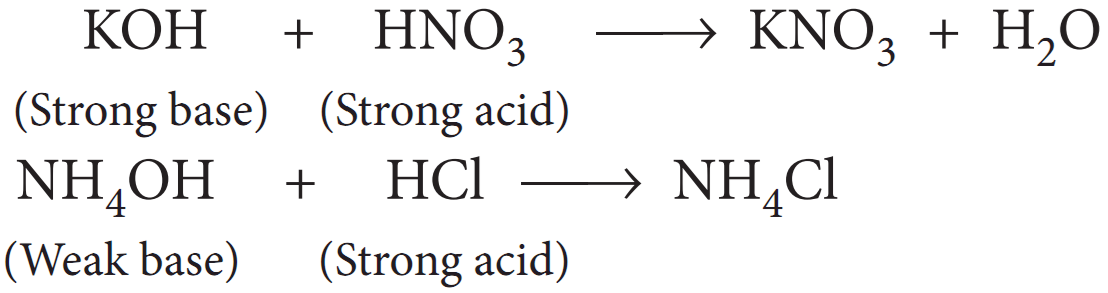
Assertion: Salt of KNO3 is formed by strong base and weak acid.
Reason: Salt of NH4Cl is formed by weak base and strong acid.
View full question & answer
Question 91 Mark
For question two statements are given-one labelled Assertion (A) and the other labelled Reason (R). Select the correct answer to these questions from the codes (a), (b), (c) and (d) as given below:
  1. Both A and R are true, and R is correct explanation of the assertion.
  2. Both A and R are true, but R is not the correct explanation of the assertion.
  3. A is true, but R is false.
  4. A is false, but R is true.
Assertion: Phosphoric acid is a weak acid.
Reason: Phosphoric acid when dissolved in water dissociates partially and produces very little H+ ions.
Answer
  1. Both A and R are true, and R is correct explanation of the assertion.
View full question & answer
Question 101 Mark
For question two statements are given-one labelled Assertion (A) and the other labelled Reason (R). Select the correct answer to these questions from the codes (a), (b), (c) and (d) as given below:
  1. Both A and R are true, and R is correct explanation of the assertion.
  2. Both A and R are true, but R is not the correct explanation of the assertion.
  3. A is true, but R is false.
  4. A is false, but R is true.
Assertion: pH of ammonium nitrate solution is acidic.
Reason: Solution of a salt of weak base and strong acid is acidic.
Answer
  1. Both A and R are true, and R is correct explanation of the assertion.

Explanation:

Ammonium nitrate is a salt of ammonium hydroxide (weak base) and nitric acid (strong acid).

View full question & answer
Question 111 Mark
For question two statements are given-one labelled Assertion (A) and the other labelled Reason (R). Select the correct answer to these questions from the codes (a), (b), (c) and (d) as given below:
  1. Both A and R are true, and R is correct explanation of the assertion.
  2. Both A and R are true, but R is not the correct explanation of the assertion.
  3. A is true, but R is false.
  4. A is false, but R is true.
Assertion: Phenolphthalein is an acid-base indicator.
Reason: Phenolphthalein gives different colours in acidic and basic medium
Answer
  1. Both A and R are true, and R is correct explanation of the assertion.

Explanation:

Phenolphthalein is a weak organic acid and may be represented as HPh.

$\text{HPh}\ \ \ \ \ \ \ \ \ \ \ \rightleftharpoons\ \ \ \ \ \ \ \ \text{H}^+\ \ \ \ \ +\ \ \ \ \ \ \ \text{Ph}^-\\\text{(Colourles)}\ \ \ \ \ \ \ \ \text{(Colourles)}\ \ \ \ \ \ \ \ \text{(Pink)}$

ln acidic medium, excess of H+ ions are present and so equilibrium is towards left and hence solution is colourless. While in basic medium, OH ions combine with H+ ions to form unionised water molecules and so equilibrium is towards right and hence solution has pink colour. Therefore, phenolphthalein is an acid acid-base indicator.

View full question & answer
Question 121 Mark
For question two statements are given-one labelled Assertion (A) and the other labelled Reason (R). Select the correct answer to these questions from the codes (a), (b), (c) and (d) as given below:
  1. Both A and R are true, and R is correct explanation of the assertion.
  2. Both A and R are true, but R is not the correct explanation of the assertion.
  3. A is true, but R is false.
  4. A is false, but R is true.
Assertion: pH = 7 signifies pure water.
Reason: pH of acetic acid is greater than 7.
Answer
  1. A is true, but R is false.

Explanation:

pH of acetic acid is less than 7.

View full question & answer
Question 131 Mark
For question two statements are given-one labelled Assertion (A) and the other labelled Reason (R). Select the correct answer to these questions from the codes (a), (b), (c) and (d) as given below:
  1. Both A and R are true, and R is correct explanation of the assertion.
  2. Both A and R are true, but R is not the correct explanation of the assertion.
  3. A is true, but R is false.
  4. A is false, but R is true.
Assertion: Higher the H+ ion concentration, lower is the pH value.
Reason: The pH of a neutral solution = 7, that of a basic solution< 7 and that of an acidic solution> 7.
Answer
  1. A is true, but R is false.

Explanation:

Higher the H+ ion concentration, lower is the pH value. The pH value less than 7 represents an acidic solution and value more than 7 represents a basic solution.

View full question & answer
Question 141 Mark
For question two statements are given-one labelled Assertion (A) and the other labelled Reason (R). Select the correct answer to these questions from the codes (a), (b), (c) and (d) as given below:
  1. Both A and R are true, and R is correct explanation of the assertion.
  2. Both A and R are true, but R is not the correct explanation of the assertion.
  3. A is true, but R is false.
  4. A is false, but R is true.
Assertion: Common salt is used for the preparation of many chemicals such as sodium hydroxide, bleaching powder, baking soda, washing soda etc.
Reason: Main source of sodium chloride is sea water.
Answer
  1. Both A and R are true, but R is not the correct explanation of the assertion.
View full question & answer
Question 151 Mark
For question two statements are given-one labelled Assertion (A) and the other labelled Reason (R). Select the correct answer to these questions from the codes (a), (b), (c) and (d) as given below:
  1. Both A and R are true, and R is correct explanation of the assertion.
  2. Both A and R are true, but R is not the correct explanation of the assertion.
  3. A is true, but R is false.
  4. A is false, but R is true.
Assertion: Cl is a stronger acid than acetic acid.
Reason: On dissociation, HCl yields lesser hydrogen ions for the same concentration as compared to acetic acid.
Answer
  1. A is true, but R is false.

Explanation:

On dissociation, HCl yields more hydrogen ions for the same concentration as compared to acetic acid. 

View full question & answer
Question 161 Mark
For question two statements are given-one labelled Assertion (A) and the other labelled Reason (R). Select the correct answer to these questions from the codes (a), (b), (c) and (d) as given below:
  1. Both A and R are true, and R is correct explanation of the assertion.
  2. Both A and R are true, but R is not the correct explanation of the assertion.
  3. A is true, but R is false.
  4. A is false, but R is true.
Assertion: CH3COOH is used as vinegar in cooking and food preservatives.
Reason: Strong acids are those acids which ionise almost completely in aqueous solution and hence produce a large amount of H+ ions.
Answer
  1. Both A and R are true, but R is not the correct explanation of the assertion.
View full question & answer
Question 171 Mark
For question two statements are given-one labelled Assertion (A) and the other labelled Reason (R). Select the correct answer to these questions from the codes (a), (b), (c) and (d) as given below:
  1. Both A and R are true, and R is correct explanation of the assertion.
  2. Both A and R are true, but R is not the correct explanation of the assertion.
  3. A is true, but R is false.
  4. A is false, but R is true.
Assertion: Calcium sulphate hemihydrate, $\text{CaSO}_4.\frac{1}{2}\text{H}_2\text{O}$ is called plaster of Paris.
Reason: Plaster of Paris is used for producing moulds for pottery and ceramics and casts of statues.
Answer
  1. Both A and R are true, but R is not the correct explanation of the assertion.
View full question & answer
Question 181 Mark
For question two statements are given-one labelled Assertion (A) and the other labelled Reason (R). Select the correct answer to these questions from the codes (a), (b), (c) and (d) as given below:
  1. Both A and R are true, and R is correct explanation of the assertion.
  2. Both A and R are true, but R is not the correct explanation of the assertion.
  3. A is true, but R is false.
  4. A is false, but R is true.
Assertion: Bleaching powder reacts with dilute acids to evolve chlorine.
Reason: The chlorine liberated by the action of dilute acids on bleaching powder is called available chlorine.
Answer
  1. Both A and R are true, but R is not the correct explanation of the assertion.

Explanation:

The reaction involved is,

$\text{CaOCl}_2\ \ +\ \ \text{H}_2\text{SO}_{4\text{(dilute)}}\ \ \xrightarrow{\ \ \ \ \ \ \ \ \ \ \ \ }\ \ \text{CaSO}_4\ \ +\ \ \text{H}_2\text{O}\ \ +\ \ \text{Cl}_2\uparrow$

View full question & answer
Question 191 Mark
For question two statements are given-one labelled Assertion (A) and the other labelled Reason (R). Select the correct answer to these questions from the codes (a), (b), (c) and (d) as given below:
  1. Both A and R are true, and R is correct explanation of the assertion.
  2. Both A and R are true, but R is not the correct explanation of the assertion.
  3. A is true, but R is false.
  4. A is false, but R is true.
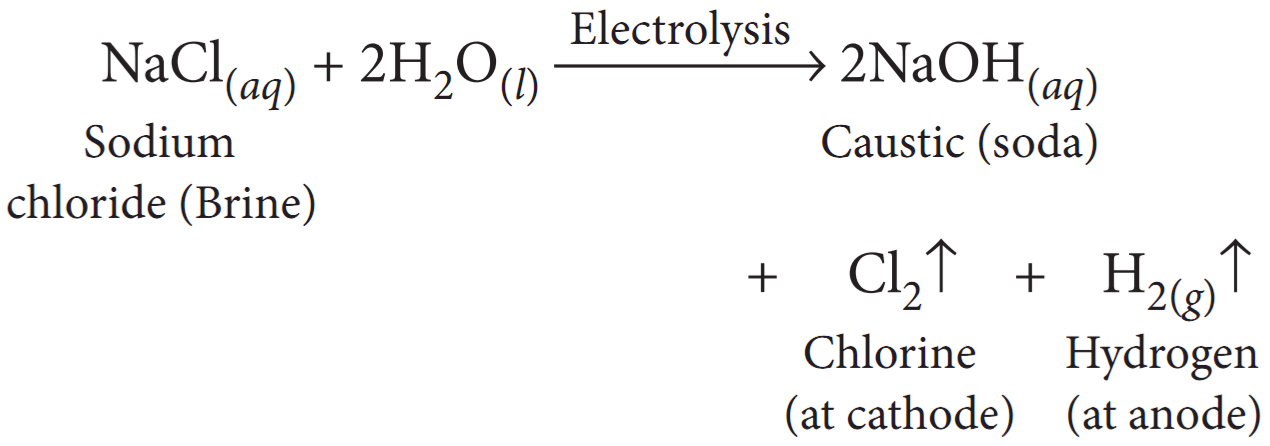
Assertion: Baking soda is prepared by chlor-alkali process.
Reason: Brine decomposes to sodium hydroxide on passing electricity through it.
View full question & answer
Question 201 Mark
For question two statements are given-one labelled Assertion (A) and the other labelled Reason (R). Select the correct answer to these questions from the codes (a), (b), (c) and (d) as given below:
  1. Both A and R are true, and R is correct explanation of the assertion.
  2. Both A and R are true, but R is not the correct explanation of the assertion.
  3. A is true, but R is false.
  4. A is false, but R is true.
Assertion: Antacids neutralize the effect of extra acid produced in the stomach during indigestion and thus provide relief.
Reason: Antacids are mild bases.
Answer
  1. Both A and R are true, and R is correct explanation of the assertion.
View full question & answer
Question 211 Mark
For question two statements are given-one labelled Assertion (A) and the other labelled Reason (R). Select the correct answer to these questions from the codes (a), (b), (c) and (d) as given below:
  1. Both A and R are true, and R is correct explanation of the assertion.
  2. Both A and R are true, but R is not the correct explanation of the assertion.
  3. A is true, but R is false.
  4. A is false, but R is true.
Assertion: AlCl3 is a basic salt.
Reason: AlCl3 is a salt of strong acid and a weak base.
Answer
  1. A is false, but R is true.

Explanation:

AlCl3 is an acidic salt as it is a salt of strong acid (HCl) and a weak base [Al(OH)3].

View full question & answer
Question 221 Mark
For question two statements are given-one labelled Assertion (A) and the other labelled Reason (R). Select the correct answer to these questions from the codes (a), (b), (c) and (d) as given below:
  1. Both A and R are true, and R is correct explanation of the assertion.
  2. Both A and R are true, but R is not the correct explanation of the assertion.
  3. A is true, but R is false.
  4. A is false, but R is true.
Assertion: Acetic acid does not act as an acid in benzene solution.
Reason: Benzene is non-polar.
Answer
  1. Both A and R are true, and R is correct explanation of the assertion.

Explanation:

For ionization of an acid or base, polar solvents (like water) are required. As ionization does not take place in non-polar solvents (like benzene) so acetic acid does not act as an acid.

View full question & answer
Assertion - Reasoning [Che-1 M] - Science STD 10 Questions - Vidyadip