MCQ
For question two statements are given $-$ one labelled Assertion and the other labelled Reason. Select the correct answer to these questions from the codes $(a), (b), (c)$ and $(d)$ as given below.
Assertion : Non $-$ native or exotic species are often introduced in a region for their economic uses.
Reason : Exotic species are considered to be a major cause of extinction of indigenous species.
  • A
    Both assertion and reason are true and reason is the correct explanation of assertion.
  • Both assertion and reason are true but reason is not the correct explanation of assertion.
  • C
    Assertion is true but reason is false.
  • D
    Both assertion and reason are false.

Answer

Correct option: B.
Both assertion and reason are true but reason is not the correct explanation of assertion.
The world is facing accelerated rates of species extinctions, largely due to human interference. There are four major causes $- (i)$ habitat loss and fragmentation $,(ii)$ over $-$ exploitation, $(iii)$ alien species invasions and $(iv)$ co $-$ extinctions.
Non $-$ native or alien species are often introduced inadvertently for their economic and other uses.
They often become invasive and drive away the local species.
The exotic species are considered to be second major cause of extinction of species $($the first being habitat destruction$)$.

Need a full question paper?

Generate a complete, print-ready paper with questions like this in minutes — across 16+ boards, with answer keys.

Start Generating Free

Similar questions

Read the following and answer any four questions from $(i)$ to $(v)$ given below:
Embryo develops at the micropylar end of the embryo sac, where the zygote is situated. Most zygotes divided only after certain amount of endosperm is formed. The early stages of embryo development are similar in both monocotyledons and dicotyledons. The zygote gives rise to the proembryo and subsequently to the globular heart-shaped and mature embryo. A typical dicotyledonous embryo consists of an embryonal axis and two cotyledons. Embryo of monocotyledons possess only one cotyledon.
  1. True embryo develops as a result of fusion of:
  1. Two polar nuclei of embryo sac.
  2. An egg cell and a male gamete.
  3. Synergid and male gamete.
  4. A male gamete and antipodals.
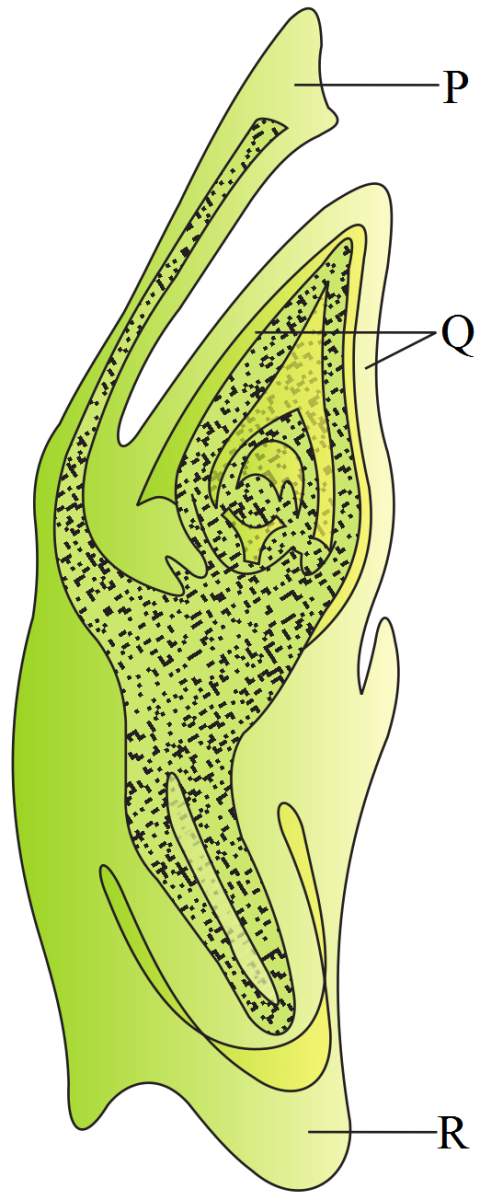
  1. Refer to the given diagram of the embryo of an angiospermous plant with parts labelled $P, Q$ and $R$. Select the correct statement$(s)$ regarding this.
  1. Part $'P\ '$ supplies nutrition to the developing embryo.
  2. Part $'Q\ '$ is the protective sheath of radicle and root cap.
  3. Part $'R\ '$ is the protective sheath of shoot apex and leaf primordia.
  4. The embryo shown in the diagram is present in members of Family Poaceae.
  1. $(IV)$ only.
  2. $(II)$ and $(III)$ only.
  3. $(I)$ and $(IV)$ only.
  4. $(I), (II), (III)$ and $(IV).$
  1. Which of the given statements are true?
  1. During the development of a dicot embryo, heart$-$shaped embryo is followed by globular embryo.
  2. The part of embryonal axis above the level of cotyledons is epicotyl, while the part below the level of cotyledons is hypocotyl.
  3. Monocot seeds possess a single cotyledon, represented by scutellum.
  1. $(I)$ and $(II).$
  2. $(II)$ and $(III).$
  3. $(I)$ and $(III).$
  4. $(I), (II)$ and $(III).$
  1. Consider the following parts of an embryonal axis of a dicot seed.
  1. Hypocotyl.
  2. Epicotyl.
  3. Radicle.
  4. Plumule.
In which of the following the above parts are correctly arranged from top to base?
  1. $(III) \rightarrow (I) \rightarrow (II) \rightarrow (IV).$
  2. $(II) \rightarrow (I) \rightarrow (III) \rightarrow (IV).$
  3. $(IV) \rightarrow (II) \rightarrow (I) \rightarrow (III).$
  4. $(III) \rightarrow (IV) \rightarrow (II) \rightarrow (I).$
  1. In grass family, the cotyledon, is called:
  1. Epiblast.
  2. Plumule.
  3. Scutellum.
  4. Perisperm.
For question two statements are given $-$ one labelled Assertion and the other labelled Reason. Select the correct answer to these questions from the codes $(a), (b), (c)$ and $(d)$ as given below.
Assertion : Kangaroo rat can live without drinking water.
Reason : This is an adaptation to water scarcity in arid conditions.
For question two statements are given$-$one labelled Assertion and the other labelled Reason. Select the correct answer to these questions from the codes $(a), (b), (c)$ and $(d)$ as given below.
Assertion: The rate of extinction of organisms have increased in recent years.
Reason: Human activities like deforestation, industrialisation, etc., have destroyed the natural habitat of plants and animals.
Two statements are given-one labelled Assertion and the other labelled Reason. Select the correct answer to these questions from the codes $(a), (b), (c)$ and $(d)$ as given below.
Assertion: An organism which acts as herbicide is called bioherbicide.
Reason: Phytophthora palmivora is a mycoherbicide.
For question two statements are given $-$ one labelled Assertion and the other labelled Reason. Select the correct answer to these questions from the codes $(a), (b), (c)$ and $(d)$ as given below.
Assertion : Indiscriminate exploitation ofeconomically important wild plants may lead to their extinction.
Reason : Non $-$ conservation of their germplasm is responsible for this.
Name any genetically modified crop.
Read the following and answer any four questions from $(i)$ to $(v)$ given below:
Pollen$-p$istil interaction is the group of events that occur from the time of pollen deposition over the stigma to the time of pollen tube entry into ovule. It is a dynamic process which has checks at several places for promotion or inhibition of pollen growth. Pollen$-$pistil interaction is a safety measure to ensure that illegitimate crossings do not occur. Compatibility and incompatibility of the pollen$-$pistil is determined by special proteins. The compatible pollens are able to absorb water and nutrients from the surface of the stigma. They germinate and produce pollen tubes. Pollen tubes grow into the style. Their growth and path through the style are also determined by specific chemicals.
  1. Which of the following parts of gynoecium determines the compatible nature of pollen?
  1. Stigma.
  2. Style.
  3. Ovary.
  4. Thalamus.
  1. In Triforium, which type of self$-$incompatibility is found?
  1. Gametophytic self$-$incompatibility $(\text{GSI}).$
  2. Sporophytic self$-$incompatibility $(\text{SSI}).$
  3. Both $\text{GSI}$ and $\text{SSI}.$
  4. None of these.
  1. Select the incorrect statement.
  1. In Asteraceae, incompatibility is due to the genotype of the sporophytic stigmatic tissues.
  2. In members of Brassicaceae, incompatibility is due to the genotype of the pollen.
  3. Nature has imposed self$-$incompatibility to avoid highly homozygous individuals, which have a very low survival value.
  4. None of these.
  1. Which of the following are examples of self incompatibility?
  1. Tobacco.
  2. Potato.
  3. Crucifers.
  4. All of these.
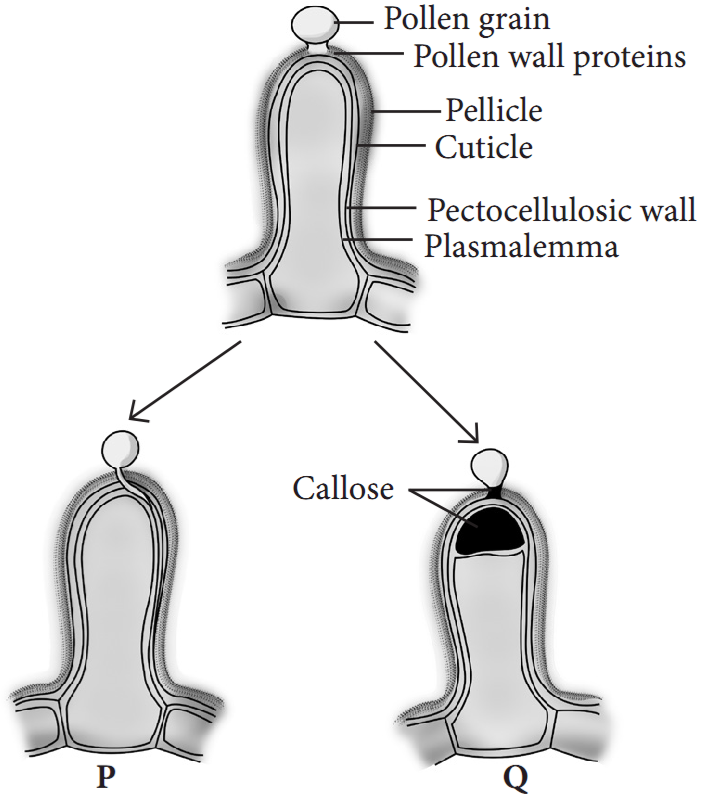
  1. Given figures show the pollen$-$stigma interaction, where pollen wall proteins are released onto the pellicle of stigmatic papillae, where a recognition reaction occurs.


Which of the following statements drawn from given figures is incorrect?
  1. $P$ indicates compatible reaction in which the pollen tube penetrates the cuticle and grows down the papilla.
  2. Development of callose plug between the plasma membrane and pectocellulosic layer of stigmatic papillae results in the incompatibility reaction in $Q$.
  3. A callose plug, which appears at the tip of pollen in $Q$, is dissolved by callase enzyme secreted by stigma resulting in compatibility reaction.
  4. Deposition of callose can be employed as a reliable bioassay to detect compatibility or incompatibility reactions of pollen and stigma.
For question two statements are given $-$ one labelled Assertion and the other labelled Reason. Select the correct answer to these questions from the codes $(a), (b), (c)$ and $(d)$ as given below.
Assertion : Phytoplanktons grow in abundance in the profundal zone of lake.
Reason : Profundal zone is illuminated by light which supports growth of phytoplanktons.
For two statements are given$-$one labelled Assertion and the other labelled Reason. Select the correct answer to these questions from the codes $(a), (b), (c)$ and $(d)$ as given below.
Assertion: Mostly in a tetrad, all microspores are free.
Reason: Compound pollen grain and pollinium are formed by grouping of microspores.
Bt toxin is harmful to insects like :