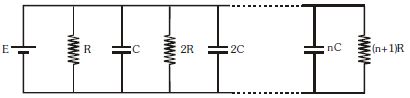
For shown situation, in steady state condition ratio of charge stored in the first and last $n^{th}$ capacitor is
Medium
Download our app for free and get started
$\mathrm{Q}_{1}=\mathrm{EC}, \mathrm{Q}_{\mathrm{n}}=\mathrm{E}(\mathrm{nC})=\mathrm{nQ}_{1} \Rightarrow \frac{\mathrm{Q}_{1}}{\mathrm{Q}_{\mathrm{n}}}=\frac{1}{\mathrm{n}}$

Download our appand get started for free
Experience the future of education. Simply download our apps or reach out to us for more information. Let's shape the future of learning together!No signup needed.*
Similar Questions
- 1A potential difference of $300\, volts$ is applied to a combination of $2.0\,\mu F$ and $8.0\,\mu F$ capacitors connected in series. The charge on the $2.0\,\mu F$ capacitor isView Solution
- 2A capacitor of capacitance $900\,\mu F$ is charged by a $100\,V$ battery. The capacitor is disconnected from the battery and connected to another uncharged identical capacitor such that one plate of uncharged capacitor connected to positive plate and another plate of uncharged capacitor connected to negative plate of the charged capacitor. The loss of energy in this process is measured as $x \times 10^{-2}\,J$. The value of $x$ is $..............$View Solution
- 3A parallel plate capacitor is made of two square parallel plates of area $A$ , and separated by a distance $d < < \sqrt A $ . The capacitor is connected to a battery with potential $V$ and allowed to fully charge. The battery is then disconnected. A square metal conducting slab also with area $A$ but thickness $\frac {d}{2}$ is then fully inserted between the plates, so that it is always parallel to the plates. How much work has been done on the metal slab by external agent while it is being inserted?View Solution
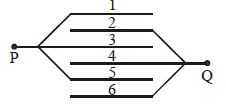
- 4Six metallic plates each with a surface area of one side $A$, are placed at a distance $d$ from each other. The alternate plates are connected to points $P$ and $Q$ as shown in figure. The capacitance of the system isView Solution
- 5View SolutionThe charge given to any conductor resides on its outer surface, because
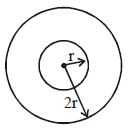
- 6If the potential of the inner shell is $10\,V$ and that of the outer shell is $5\,V$, then potential at the centre will be....$V$View Solution
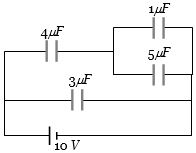
- 7The charge on $4\, \mu F$ capacitor in the given circuit is .... in $\mu C$View Solution
- 8The potential at a point $x$ (measured in $μ\ m$) due to some charges situated on the $ x$-axis is given by $V(x)$ =$\frac{{20}}{{{x^2} - 4}}$ $volt$ The electric field $E$ at $x = 4\ μ m$ is given byView Solution
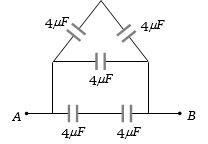
- 9Equivalent capacitance between $A$ and $B$ is......$\mu \,F$View Solution
- 10Consider two charged metallic spheres $S_{1}$ and $\mathrm{S}_{2}$ of radii $\mathrm{R}_{1}$ and $\mathrm{R}_{2},$ respectively. The electric $\left.\text { fields }\left.\mathrm{E}_{1} \text { (on } \mathrm{S}_{1}\right) \text { and } \mathrm{E}_{2} \text { (on } \mathrm{S}_{2}\right)$ on their surfaces are such that $\mathrm{E}_{1} / \mathrm{E}_{2}=\mathrm{R}_{1} / \mathrm{R}_{2} .$ Then the ratio $\left.\mathrm{V}_{1}\left(\mathrm{on}\; \mathrm{S}_{1}\right) / \mathrm{V}_{2} \text { (on } \mathrm{S}_{2}\right)$ of the electrostatic potentials on each sphere isView Solution