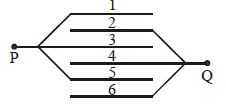
Six metallic plates each with a surface area of one side $A$, are placed at a distance $d$ from each other. The alternate plates are connected to points $P$ and $Q$ as shown in figure. The capacitance of the system is
Medium


Download our appand get started for free
Experience the future of education. Simply download our apps or reach out to us for more information. Let's shape the future of learning together!No signup needed.*
Similar Questions
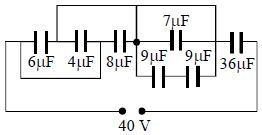
- 1In the following diagram, the charge and potential difference across $8\,\mu F$ capacitance will be nearlyView Solution
- 2Capacitance of a parallel plate capacitor becomes $4/3$ times its original value if a dielectric slab of thickness $t = d/2$ is inserted between the plates ($d$ is the separation between the plates). The dielectric constant of the slab isView Solution
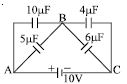
- 3In the circuit shown in figure, four capacitors are connected to a battery. The charge on the $5$ $\mu$$F$ capacitor is.......$ \mu C$View Solution
- 4A parallel plate condenser is connected with the terminals of a battery. The distance between the plates is $6\,mm$. If a glass plate (dielectric constant $K = 9$) of $4.5\,mm$ is introduced between them, then the capacity will become.......$times$View Solution
- 5View SolutionA parallel plate capacitor is charged to a certain potential and the charging battery is then disconnected. Now, if the plates of the capacitor are moved apart then:
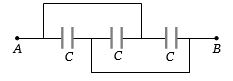
- 6Three equal capacitors, each with capacitance $C$ are connected as shown in figure. Then the equivalent capacitance between $A$ and $B$ isView Solution
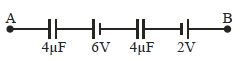
- 7A part of circuit is given here, if $V_A-V_B = 4V$ then find charge on $4\,\mu F$ capacitor.....$\mu C$View Solution
- 8A capacitor with capacitance $5\,\mu F$ is charged to $5\,\mu C.$ If the plates are pulled apart to reduce the capacitance to $2\,\mu F,$ how much work is done?View Solution
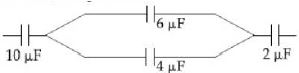
- 9In the figure shown below, the charge on the left plate of the $10\, \mu F$ capacitor is $-30\,\mu C.$ The charge on the right place of the $6\,\mu F$ capacitor is.....$\mu C$View Solution
- 10View SolutionFor the situation shown in the figure below, mark out the correct statement