Question
The nucleus $^{23}_{10}\text{Ne}$ decays by $\beta$ emission. Write down the $\beta$-decay equation and determine the maximum kinetic energy of the electrons emitted. Given that:
$\text{m}(^{23}_{10}\text{Ne})=22.994466\text{ u}.$
$\text{m}(^{23}_{10}\text{Na})=22.089770\text{ u}.$
Answer

The $\beta$-decay of $^{23}_{10}\text{Ne}$ may be represented as:
$^{23}_{10}\text{Ne}\rightarrow\ ^{23}_{11}\text{Na }\ -\ ^{0}_{-1}\text{e }\ +\ \overline{\text{v}}\ +\ \text{Q}$
Ignoring the rest mass of antineutrino $(\overline{\text{v}})$ and electron, we get Mass defect,
$\Delta\text{m}=\text{m}(^{23}_{10}\text{Ne})-\text{m}(^{23}_{11}\text{Na})$
= 22.994466 - 22.989770
= 0.004696 u
$\therefore\ \text{Q}=0.004696\times931\text{ MeV}=4.372\text{ MeV}.$
This energy of 4.3792 MeV, is shared by e- and $\overline{\text{v}}$ pair because, $^{23}_{11}\text{Na}$ is very massive.
The maximum K.E. of e- = 4.372 MeV, when energy carried by $\overline{\text{v}}$ is zero.

Need a full question paper?

Generate a complete, print-ready paper with questions like this in minutes — across 16+ boards, with answer keys.

Start Generating Free

Similar questions

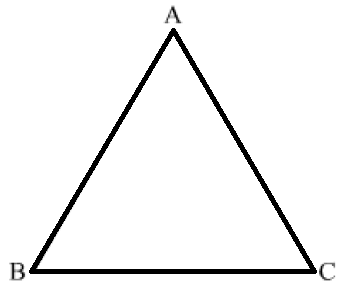
  1. A ray of light incident on face AB of an equilateral glass prism, shows minimum deviation of 30°. Calculate the speed of light through the prism.

  1. Find the angle of incidence at face AB so that the emergent ray grazes along the face AC.
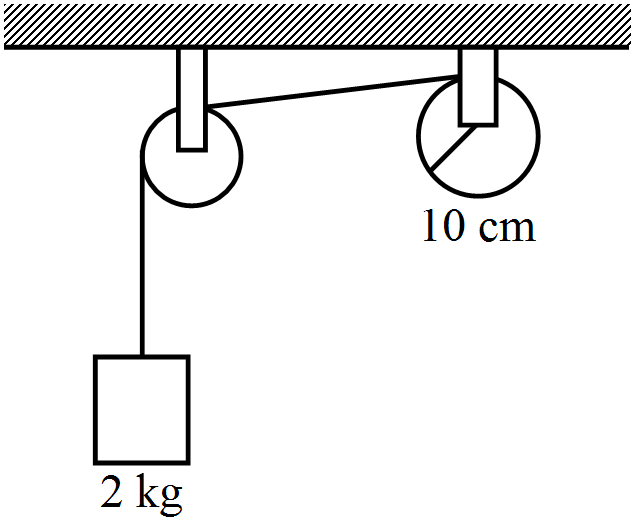
A string is wrapped on a wheel of moment of inertia 0.20kg-m2 and radius 10cm and goes through a light pulley to support a block of mass 2.0kg as shown in figure. Find the acceleration of the block.

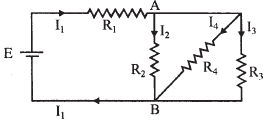
In the circuit shown, R1 = 4Ω, R2 = R3 = 15Ω, R4 = 30Ω and E = 10V. Calculate. The equivalent resistance of the circuit and the current in each resistor.

  1. Why photoelectric effect can not be explained on the basis of wave nature of light? Give reasons.
  2. Write the basic features of photon picture of electromagnetic radiation on which Einstein’s photoelectric equation is based.
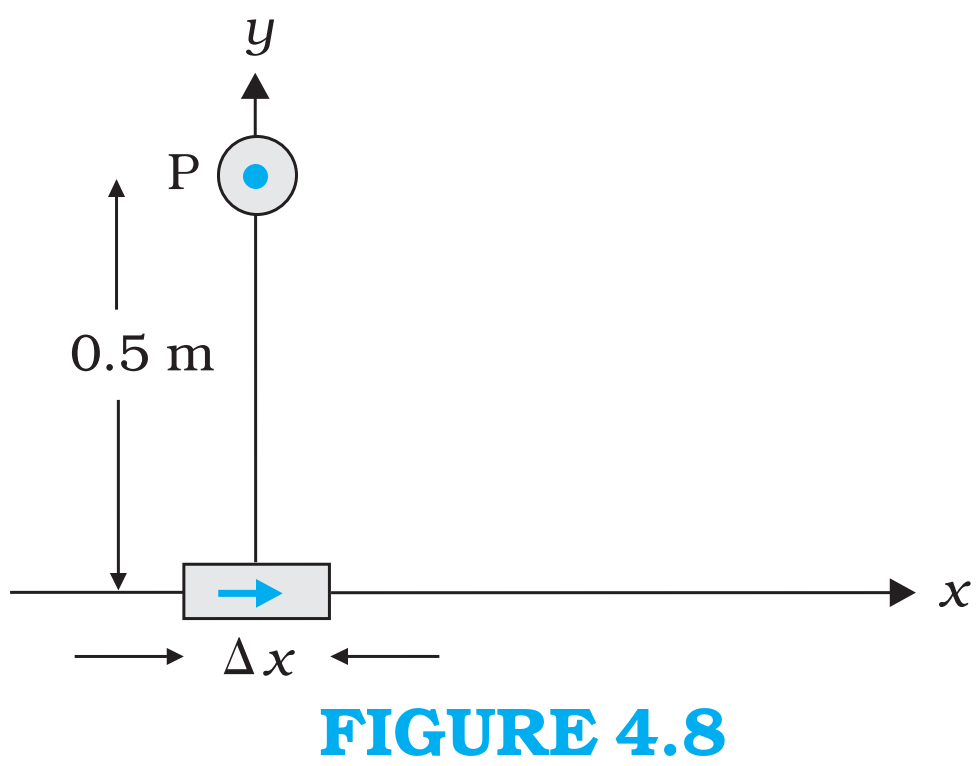
An element $\Delta l =\Delta x \hat{ i }$ is placed at the origin and carries a large current $I=10$ A (Fig. 4.8). What is the magnetic field on the $y$ axis at a distance of $0.5 m . \Delta x=1 cm$.
Image
A uniform magnetic field of magnitude 0.20T exists in space from east to west. With what speed should a particle of mass 0.010g and with charge 1.0 × 10⁻⁵C be projected from south to north so that it moves with uniform velocity?
Explain Electro static potential energy.
How are em waves produced by oscillating charges? Draw a sketch of linearly polarised em waves propagating in the Z-direction. Indicate the directions of the oscillating electric and magnetic fields.
With the help of an example, explain how the neutron to proton ratio changes during $\alpha-$decay of a nucleus.
A positive point charge (+ q) is kept in the vicinity of an uncharged conducting plate. Sketch electric field lines originating from the point on to the surface of the plate.
Derive the expression for the electric field at the surface of a charged conductor.