Question
For the $\beta^{+}$ (positron) emission from a nucleus, there is another competing process known as electron capture (electron from an inner orbit, say, the K–shell, is captured by the nucleus and a neutrino is emitted).
$\text{e}^{+}+^{\text{A}}_{\text{Z}}\text{X}\rightarrow\ ^{\text{A}}_{\text{Z}-1}\text{Y}+\text{v}$
Show that if $\beta^{+}$ emission is energetically allowed, electron capture is necessarily allowed but not vice–versa.
Answer

Let the amount of energy released during the electron capture process be Q1. The nuclear reaction can be written as:
$\text{e}^{+}+^{\text{A}}_{\text{Z}}\text{X}\rightarrow^{\text{A}}_{\text{Z}-1}\text{Y}+\text{v}+\text{Q}_1\ \dots(1)$
Let the amount of energy released during the positron capture process be Q2. The nuclear reaction can be written as:
$^{\text{A}}_{\text{Z}}\text{X}\rightarrow^{\text{A}}_{\text{Z}-1}\text{Y}+\text{e}^{+}+\text{v}+\text{Q}_2\ \dots(2)$
$\text{m}_\text{N}(^{\text{A}}_{\text{Z}}\text{X})$ = Nuclear mass of $^{\text{A}}_{\text{Z}}\text{X}$
$\text{m}_\text{N}(_{\text{Z}-1}^\text{A}\text{Y})$ = Nuclear mass of $_{\text{Z}-1}^{\text{A}}\text{Y}$
$\text{m}(^{\text{A}}_{\text{Z}}\text{X})$ = Atomic mass of $^\text{A}_\text{Z}\text{X}$
$\text{m}(^{\text{A}}_{\text{Z}-1}\text{Y})$ = Atomic mass of $^{\text{A}}_{\text{Z}-1}\text{Y}$
me = Mass of an electron
c = Speed of light
Q-value of the electron capture reaction is given as:
$\text{Q}_1=\Big[\text{m}_{\text{N}}(^{\text{A}}_{\text{Z}}\text{X})+\text{m}_{\text{e}}-\text{m}_{\text{N}}(^{\text{A}}_{\text{Z}-1}\text{Y})\Big]\text{c}^2$
$=\Big[\text{m}(^{\text{A}}_{\text{Z}}\text{X})-\text{Zm}_\text{e}+\text{m}_\text{e}-\text{m}(^{\text{A}}_{\text{Z}-1}\text{Y})+(\text{Z}-1)\text{m}_\text{e}\Big]\text{c}^2$
$=\Big[\text{m}(^{\text{A}}_{\text{Z}}\text{X})-\text{m}(^{\text{A}}_{\text{Z}-1}\text{Y})\Big]\text{c}^2$
Q-value of the positron capture reaction is given as:
$\text{Q}_2=\Big[\text{m}_{\text{N}}(^{\text{A}}_{\text{Z}}\text{X})-\text{m}_{\text{N}}(^{\text{A}}_{\text{Z}-1}\text{Y})-\text{m}_\text{e}\Big]\text{c}^2$
$=\Big[\text{m}(^{\text{A}}_{\text{Z}}\text{X})-\text{Zm}_\text{e}-\text{m}(^{\text{A}}_{\text{Z}-1}\text{Y})+(\text{Z}-1)\text{m}_\text{e}-\text{m}_\text{e}\Big]\text{c}^2$
$=\Big[\text{m}(^{\text{A}}_{\text{Z}}\text{X})-\text{m}(^{\text{A}}_{\text{Z}-1}\text{Y})-2\text{m}_\text{e}\Big]\text{c}^2$
It can be inferred that if Q> 0, then Q1 > 0; Also, if Q1 > 0, it does not necessarily mean that Q2 > 0.

Need a full question paper?

Generate a complete, print-ready paper with questions like this in minutes — across 16+ boards, with answer keys.

Start Generating Free

Similar questions

(a) A point-image (object) is placed on the principal axis of a convex spherical surface of radius of curvature $R$, the refractive index of the medium on one side of this surface is $n _1$ and the refractive index of the medium on the other side is $n_2$, where $n_2>n_1$. For this, draw a ray diagram and derive the relation between object distance $(u)$, image distance $(v)$ and radius of curvature $( R )$ for refraction from rarer medium to denser medium on a convex spherical surface.
(b) Use the above relation in terms of $n_1$ and $n_2$, to obtain the condition for the position of the object and the radius of curvature when a real image is formed.
  1. Draw the ray diagram showing refraction of light through a glass prism and hence obtain the relation between the refractive index $\mu$ of the prism, angle of prism and angle of minimum deviation.
  2. Determine the value of the angle of incidence for a ray of light travelling from a medium of refractive index $\mu_1=\sqrt{2}$ into the medium of refractive index $\mu_2=1$, so that it just grazes along the surface of separation.
  1. Compare the individual dipole moment and the specimen dipole moment for H2O molecule and O2 molecule when placed in:
  1. Absence of external electric field.
  2. Presence of external eclectic field. Justify your answer.
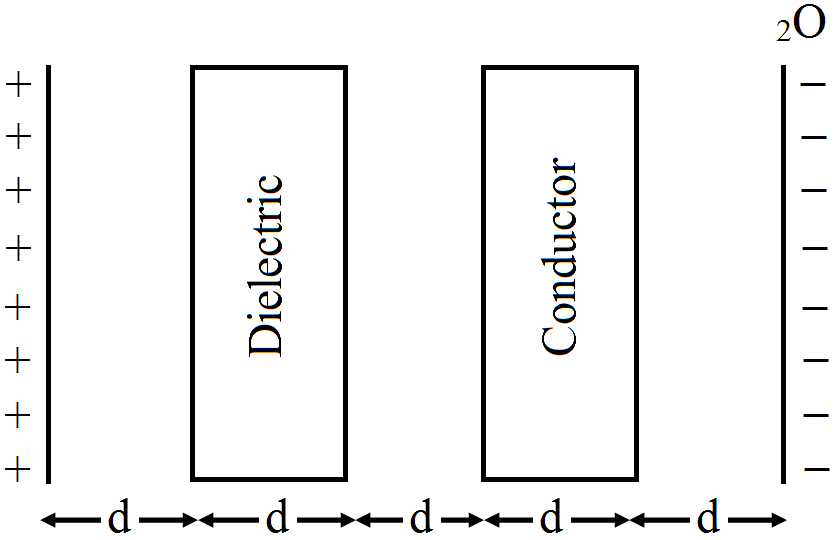
  1. Given two parallel conducting plates of area A and charge densities $+\sigma$ and $-\sigma.$ A dielectric slab of constant K and a conducting slab of thickness d each are inserted in between them as shown.

  1. Find the potential difference between the plates.
  2. Plot E versus x graph, taking x = 0 at positive plate and x = 5d at negative plate.
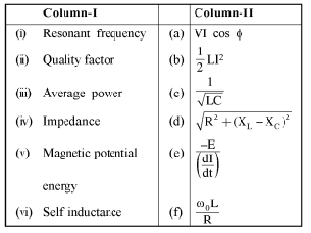
Match the following
Image
In an experiment on photoelectric effect, the stopping potential is measured for monochromatic light beams corresponding to different wavelengths. The data collected are 11s follows:

wavelength (nm) 350 400 450 500 550
stopping potential(V): 1.45 1.00 0.66 0.38 0.16

Plot the stopping potential against inverse of wavelength $\big(\frac{1}{\lambda}\big) $ on a graph paper and find

  1. The Planck constant,
  2. The work function of the emitter and.
  3. The threshold wavelength.
Do permeability and relative permeability have the same dimensions?
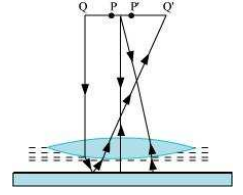
equiconvex lens (of refractive index 1.50) in contact with a liquid layer on top of a plane mirror. A small needle with its tip on the principal axis is moved along the axis until its inverted image is found at the position of the needle. The distance of the needle from the lens is measured to be 45.0 cm. The liquid is removed and the experiment is repeated. The new distance is measured to be 30.0 cm. What is the refractive index of the liquid?

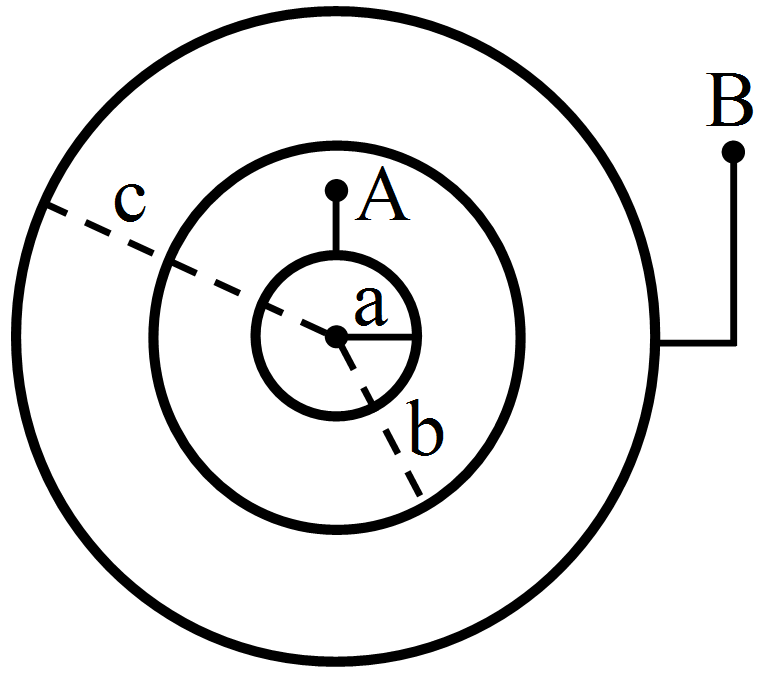
Consider an assembly of three conducting concentric spherical shells of radii a, b and c as shown in figure. Find the capecitance of the assembly between the poima A and B

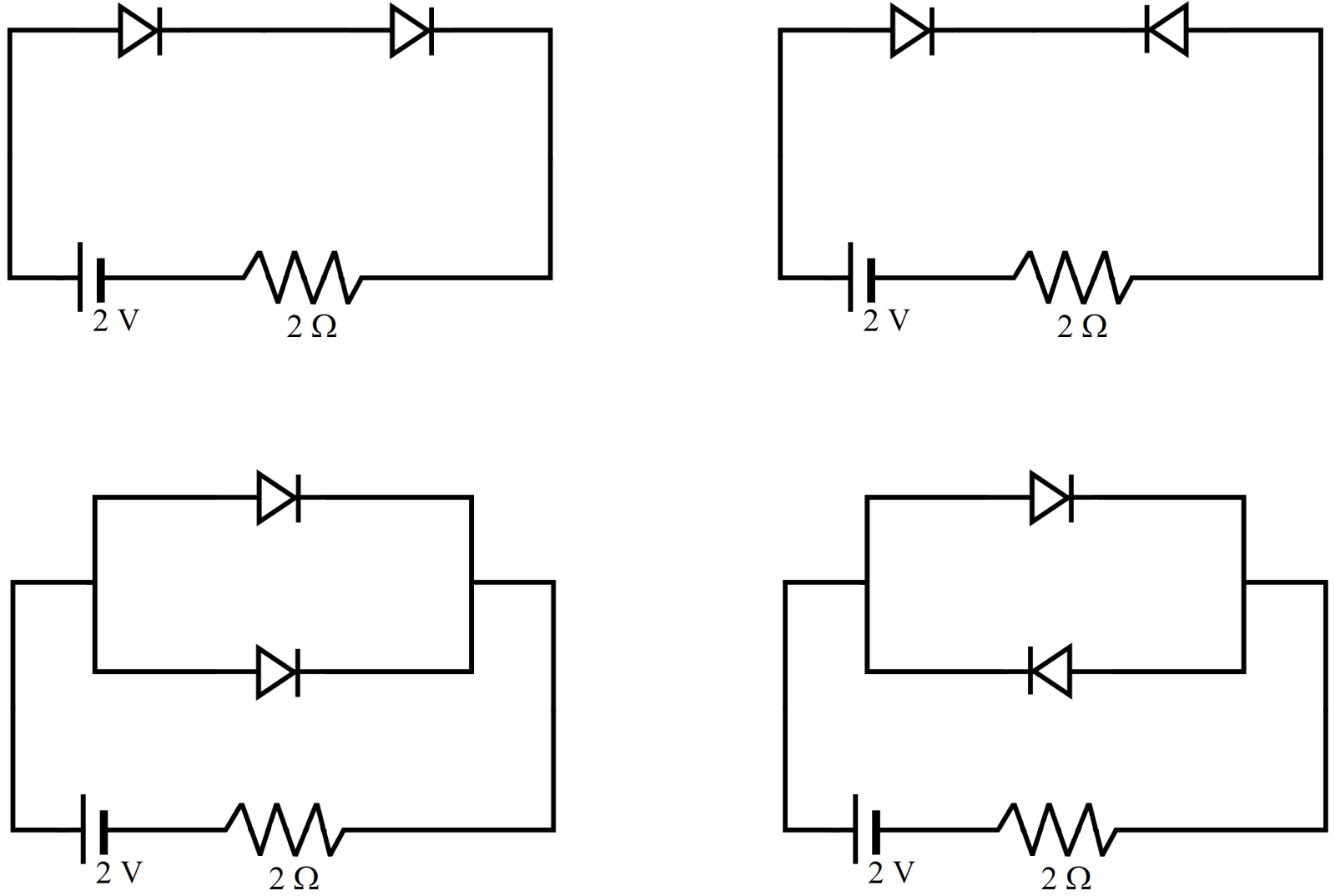
Find the currents through the resistances in the circuits shown in figure.

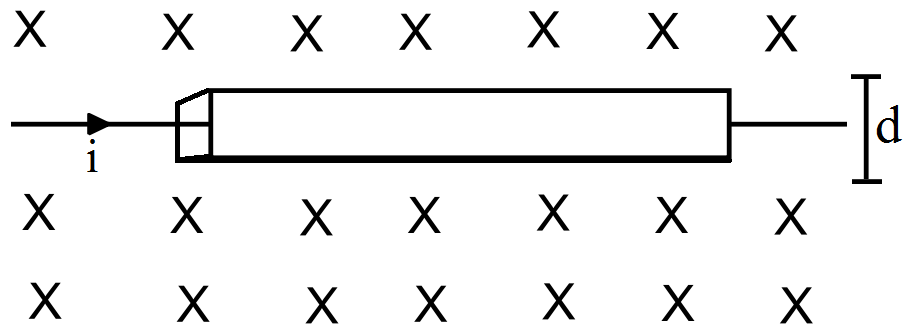
A current i is passed through a silver strip of width d and area of cross-section A. The number of free electrons per unit volume is n.
  1. Find the drift velocity v of the electrons.
  2. If a magnetic field B exists in the region, as shown in the figure, what is the average magnetic force on the free electrons?
  3. Due to the magnetic force, the free electrons get accumulated on one side of the conductor along its length. This produces a transverse electric field in the conductor, which opposes the magnetic force on the electrons. Find the magnitude of the electric field which will stop further accumulation of electrons.
  4. What will be the potential difference developed across the width of the conductor due to the electron-accumulation? The appearance of a transverse emf, when a current-carrying wire is placed in a magnetic field, is called Hall effect.