MCQ
Image
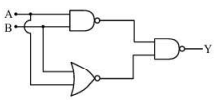
For the circuit shown above, equivalent GATE is:
  • OR gate
  • B
    NOT gate
  • C
    AND gate
  • D
    NAND gate

Answer

Correct option: A.
OR gate
A

Need a full question paper?

Generate a complete, print-ready paper with questions like this in minutes — across 16+ boards, with answer keys.

Start Generating Free

Similar questions

A medium can carry a longitudinal wave because it has the property of
The intensity at the maximum in a Young's double slit experiment is $I_0$. Distance between two slits is $d = 5\lambda,$ where $\lambda$ is the wavelength of light used in the experiment. What will be the intensity in front of one of the slits on the screen placed at a distance $D = 10\,d\,?$
Two charges $ + 3.2 \times {10^{ - 19}}\,C$ and $ - 3.2 \times {10^{ - 19}}\,C$ kept $2.4\, \mathop A\limits^o $ apart forms a dipole. If it is kept in uniform electric field of intensity $4 \times {10^5}\,volt/m$ then what will be its electrical energy in equilibrium
Three sound waves of equal amplitudes have frequencies $(n - 1 ), n, (n + 1 ).$ They superimpose to give beats. The number of beats produced per second will be 
A juggler tosses a ball up in the air with initial speed $u$. At the instant, it reaches its maximum height $H$, he tosses up a second ball with the same initial speed. The two balls will collide at a height
Assertion : Lenz's law violates the principle of conservation of energy.

Reason : Induced $emf$ always opposes the change in magnetic flux responsible for its production.

Electric flux through a surface of area $100$ $m^2$ lying in the $xy$ plane is (in $V-m$) if $\vec E = \hat i + \sqrt 2 \hat j + \sqrt 3 \hat k$
The electric and the magnetic field, associated with an e.m. wave, propagating along the $+\, z-$axis, can be represented by
The total charge induced in a conducting loop when it is moved in magnetic field depends on
A short electric dipole has a dipole moment of $16 \times 10^{-9}\, Cm .$ The electric potential due to the dipole at a point at a distance of $0.6\, m$ from the centre of the dipole, situated on a line making an angle of $60^{\circ}$ with the dipole axis is $.........V$

$\left(\frac{1}{4 \pi \in_{0}}=9 \times 10^{9} Nm ^{2} / C ^{2}\right)$