Three sound waves of equal amplitudes have frequencies $(n - 1 ), n, (n + 1 ).$ They superimpose to give beats. The number of beats produced per second will be
NEET 2016,AIEEE 2009, Medium


Download our appand get started for free
Experience the future of education. Simply download our apps or reach out to us for more information. Let's shape the future of learning together!No signup needed.*
Similar Questions
- 1A pulse is generated at lower end of a hanging rope of uniform density and length $L$. The speed of the pulse when it reaches the mid point of rope is ......View Solution

- 2The path Difference between the two waves ${y_1} = {a_1}\,\sin \,\left( {\omega t - \frac{{2\pi x}}{\lambda }} \right)$ and ${y_2} = {a_2}\,\cos \,\left( {\omega t - \frac{{2\pi x}}{\lambda } + \phi } \right)$ isView Solution
- 3$y = a\cos (kx + \omega t)$ superimposes on another wave giving a stationary wave having node at $x = 0.$ What is the equation of the other waveView Solution
- 4When two sound waves with a phase difference of $\pi /2$, and each having amplitude $A$ and frequency $\omega $, are superimposed on each other, then the maximum amplitude and frequency of resultant wave isView Solution
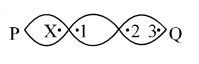
- 5Figure, shows a stationary wave between two fixed points $P$ and $Q$. Which point$(s)$ of $1, 2$ and $3$ are in phase with the point $X?$View Solution
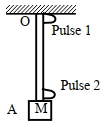
- 6A block $\mathrm{M}$ hangs vertically at the bottom end of a uniform rope of constant mass per unit length. The top end of the rope is attached to a fixed rigid support at $O$. A transverse wave pulse (Pulse $1$ ) of wavelength $\lambda_0$ is produced at point $O$ on the rope. The pulse takes time $T_{O A}$ to reach point $A$. If the wave pulse of wavelength $\lambda_0$ is produced at point $A$ (Pulse $2$) without disturbing the position of $M$ it takes time $T_{A 0}$ to reach point $O$. Which of the following options is/are correct?View Solution
(image)
[$A$] The time $\mathrm{T}_{A 0}=\mathrm{T}_{\mathrm{OA}}$
[$B$] The velocities of the two pulses (Pulse $1$ and Pulse $2$) are the same at the midpoint of rope.
[$C$] The wavelength of Pulse $1$ becomes longer when it reaches point $A$.
[$D$] The velocity of any pulse along the rope is independent of its frequency and wavelength.
- 7A wave travelling along positive $x-$ axis is given by $y = A\sin (\omega \,t - kx)$. If it is reflected from rigid boundary such that $80\%$ amplitude is reflected, then equation of reflected wave isView Solution
- 8In an experiment to measure the speed of sound by a resonating air column, a tuning fork of frequency $500 Hz$ is used. The length of the air column is varied by changing the level of water in the resonance tube. Two successive resonances are heard at air columns of length $50.7 cm$ and $83.9 cm$. Which of the following statements is (are) true?View Solution
$(A)$ The speed of sound determined from this experiment is $332 m s ^{-1}$
$(B)$ The end correction in this experiment is $0.9 cm$
$(C)$ The wavelength of the sound wave is $66.4 cm$
$(D)$ The resonance at $50.7 cm$ corresponds to the fundamental harmonic
- 9A particle on the trough of a wave at any instant will come to the mean position after a time ($T =$ time period)View Solution
- 10A train is moving on a straight track with speed $20\ ms^{-1}$. It is blowing its whistle at the frequency of $1000\ Hz$. The percentage change in the frequency heard by a person standing near the track as the train passes him is ( speed of sound $=320$ $ms^{-1}$ ) close to .... $\%$View Solution