Rate of cooling at $600K$ , if surrounding temperature is $300K$ is $R$ . The rate of cooling at $900K$ is
Medium


Download our appand get started for free
Experience the future of education. Simply download our apps or reach out to us for more information. Let's shape the future of learning together!No signup needed.*
Similar Questions
- 1If the temperature of a black body be increased from ${27^o}C$ to ${327^o}C$ the radiation emitted increases by a fraction ofView Solution
- 2A solid sphere and a hollow sphere of the same material and size are heated to the same temperature and allowed to cool in the same surroundings. If the temperature difference between each sphere and its surroundings is $T$, thenView Solution
- 3Temperature of water at the surface of lake is $ - {20^o}C$ Then temperature of water just below the lower surface of ice layer is ...... $^oC$View Solution
- 4View SolutionIn which process, the rate of transfer of heat is maximum
- 5A black body at a temperature of $127°C$ radiates heat at the rate of $1 cal/cm^2 × sec$. At a temperature of $527°C$ the rate of heat radiation from the body in ($cal/cm^2 × sec$) will beView Solution
- 6A black body of surface area $10cm^2$ is heated to $127°C$ and is suspended in a room at temperature $27°C$ . The initial rate of loss of heat from the body at the room temperature will be ...... $W$View Solution
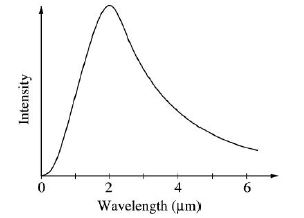
- 7The distribution of relative intensity $I (\lambda)$ of blackbody radiation from a solid object versus the wavelength $\lambda$ is shown in the figure. If the Wien displacement law onstant is $2.9 × 10^{-3}\ mK$, what is the approximate temperature of the object ....... $K$View Solution
- 8View SolutionFor a perfectly black body, its absorptive power is
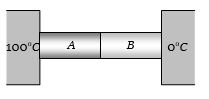
- 9Two metal cubes $A$ and $B$ of same size are arranged as shown in the figure. The extreme ends of the combination are maintained at the indicated temperatures. The arrangement is thermally insulated. The coefficients of thermal conductivity of $A$ and $B$ are $300\;W/m{\;^o}C$ and $200\;W/m{\;^o}C$, respectively. After steady state is reached, the temperature of the interface will be...... $^oC$View Solution
- 10Three rods of identical area of cross-section and made from the same metal form the sides of an isosceles triangle $ABC$, right angled at $B$. The points $A$ and $B$ are maintained at temperatures $T$ and $\sqrt 2 T$ respectively. In the steady state the temperature of the point C is ${T_C}$. Assuming that only heat conduction takes place, $\frac{{{T_C}}}{T}$ is equal toView Solution