MCQ
For the function $\text{f}(\text{x})=\text{x}+1\text{x},\text{x}\in[1,3],$ the value of $c$ for the Lagrange's mean value theorem is :
  • A
    $1$
  • $\sqrt3$
  • C
    $2$
  • D
    None of these

Answer

Correct option: B.
$\sqrt3$
We have
$\text{f}(\text{x})=\text{x}+\frac{1}{\text{x}}=\frac{\text{x}^2+1}{\text{x}}$
Clearly, $f(x)$ is continuous on $[1, 3]$ and derivable on $(1, 3).$
Thus, both the conditions of Lagrange's theorem is satisfied.
Concequently there exists $\text{c}\in(1,3)$ such that
$\text{f}\ '(\text{c})=\frac{\text{f}(3)-\text{f}(1)}{3-1}=\frac{\text{f}(3)-\text{f}(1)}{2}$
Now, $\text{f}(\text{x})=\frac{\text{x}^2+1}{\text{x}}$
$\text{f}\ '(\text{x})=\frac{\text{x}^2-1}{\text{x}^2},\text{f}(1)=2,\text{f}(3)=\frac{10}{3}$
$\therefore\ \text{f}\ '(\text{x})=\frac{\text{f}(3)-\text{f}(1)}{2}$
$\Rightarrow\frac{\text{x}^2-1}{\text{x}^2}=\frac{4}{6}$
$\Rightarrow\frac{\text{x}^2-1}{\text{x}^2}=\frac{2}{3}$
$\Rightarrow3\text{x}^2-3=2\text{x}^2$
$\Rightarrow\text{x}=\pm\sqrt3$
Thus, $\text{c}=\sqrt3\in(1,3)$ such that $\text{f}\ '(\text{c})=\frac{\text{f}(3)-\text{f}(1)}{3-1}.$

Need a full question paper?

Generate a complete, print-ready paper with questions like this in minutes — across 16+ boards, with answer keys.
Start Generating Free

Similar questions

If $y=a e^x+b e^{-x}+c$, where $a, b, c$ are parameters, then $y^{\prime}$ is equal to
For binary operation $\times$ defind on $R – \{1\}$ such that $\text{a}\times\text{b}=\frac{\text{a}}{\text{b}+1}$ is:
In graphical solutions of linear inequalities, solution can be divided into.
The area of region bounded by curve $\text{y}=\cos2\text{x},$ line $\text{x}=0$ $\text{x}=\frac{\pi}{3}$ is:
If order of A + B is n × n, then the order of AB is:
$\mathop {\lim }\limits_{n \to \infty } \frac{1}{{{n^2}}}\left[ {\cos \frac{1}{{{n^2}}} + 2\cos \frac{4}{{{n^2}}} + 3\cos \frac{9}{{{n^2}}} + .... + 2n\,\cos 4} \right]$ is equal to-
Let $\quad \vec{a}=3 \hat{i}+\hat{j}-2 \hat{k}, \quad \vec{b}=4 \hat{i}+\hat{j}+7 \hat{k} \quad$ and $\overrightarrow{\mathrm{c}}=\hat{\mathrm{i}}-3 \hat{\mathrm{j}}+4 \hat{\mathrm{k}}$ be three vectors. If a vectors $\overrightarrow{\mathrm{p}}$ satisfies $\overrightarrow{\mathrm{p}} \times \overrightarrow{\mathrm{b}}=\overrightarrow{\mathrm{c}} \times \overrightarrow{\mathrm{b}}$ and $\overrightarrow{\mathrm{p}} \cdot \overrightarrow{\mathrm{a}}=0$, then $\overrightarrow{\mathrm{p}} \cdot(\hat{\mathrm{i}}-\hat{\mathrm{j}}-\hat{\mathrm{k}})$ is equal to
The system of linear equations:
x + y + z = 2
2x + y − z = 3
3x + 2y + kz = 4
has a unique solution if
The value of $C$ for which $P\,(X = k) = C{k^2}$ can serve as the probability function of a random variable $X$ that takes $0, 1, 2, 3, 4$ is
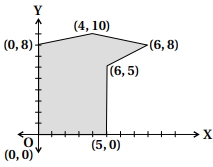
The feasible solution for a LPP is shown in Figure Let $z=3 x-4 y$ be the objective function. (Maximum value of $z+$ Minimum value of $z$ ) is equal to $....$