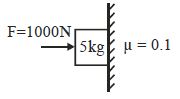
For the given figure, if block remains in equilibrium position then find frictional force between block and wall ........ $N$
Medium
Download our app for free and get started
$\begin{array}{rl}{\mathrm{F}=\mathrm{N}=1000 \mathrm{N}} & {\mathrm{f}_{\mathrm{L}}=1000 \times 0.1=100 \mathrm{N}} \\ {\mathrm{F}_{\mathrm{req}}=50 \mathrm{N}(\mathrm{mg})} & {\because \mathrm{f}_{\mathrm{req}}<\mathrm{f}_{\mathrm{L}}} \\ {\therefore} & {\mathrm{f}_{\mathrm{req}}=50 \mathrm{N}}\end{array}$

Download our appand get started for free
Experience the future of education. Simply download our apps or reach out to us for more information. Let's shape the future of learning together!No signup needed.*
Similar Questions
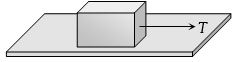
- 1In the figure shown, a block of weight $10 \,N$ resting on a horizontal surface. The coefficient of static friction between the block and the surface ${\mu _s} = 0.4$. A force of $3.5\, N$ will keep the block in uniform motion, once it has been set in motion. A horizontal force of $3 \,N$ is applied to the block, then the block willView Solution
- 2$STATEMENT-1$ It is easier to pull a heavy object than to push it on a level ground. andView Solution
$STATEMENT-2$ The magnitude of frictional force depends on the nature of the two surfaces in contact.
- 3$STATEMENT-1$ It is easier to pull a heavy object than to push it on a level ground. andView Solution
$STATEMENT-2$ The magnitude of frictional force depends on the nature of the two surfaces in contact.
- 4View SolutionA uniform metal chain is placed on a rough table such that one end of chain hangs down over the edge of the table. When one-third of its length hangs over the edge, the chain starts sliding. Then, the coefficient of static friction is
- 5A cyclist riding the bicycle at a speed of $14\sqrt 3 ms^{-1}$takes a turn around a circular road of radius $20\sqrt 3 $ m without skidding. Given $g = 9.8 ms^{-2},$ what is his inclination to the vertical ....... $^o$View Solution
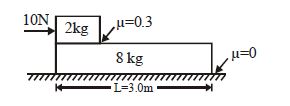
- 6Determine the time in which the smaller block reaches other end of bigger block in the figure. $(g = 10\ m s^{-2})$ .......... $\sec$View Solution
- 7The maximum velocity (in $ms^{-1}$) with which a car driver must traverse a flat curve of radius $150 \,m$ and coefficient of friction $0.6$ to avoid skidding isView Solution
- 8A mass of $100\, gm$ is tied to one end of a string $2 \,m$ long. The body is revolving in a horizontal circle making a maximum of $200$ revolutions per min. The other end of the string is fixed at the centre of the circle of revolution. The maximum tension that the string can bear is .......... $N$. (approximately)View Solution
- 9For a body moving in a circular path, a condition for no skidding if $\mu $ is the coefficient of friction, isView Solution
- 10View SolutionOn a railway curve, the outside rail is laid higher than the inside one so that resultant force exerted on the wheels of the rail car by the tops of the rails will