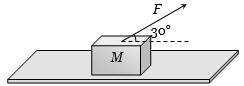
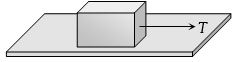
In the figure shown, a block of weight $10 \,N$ resting on a horizontal surface. The coefficient of static friction between the block and the surface ${\mu _s} = 0.4$. A force of $3.5\, N$ will keep the block in uniform motion, once it has been set in motion. A horizontal force of $3 \,N$ is applied to the block, then the block will
Easy


Download our appand get started for free
Experience the future of education. Simply download our apps or reach out to us for more information. Let's shape the future of learning together!No signup needed.*
Similar Questions
- 1A block is at rest on an inclined plane making an angle $\alpha $ with the horizontal. As the angle $\alpha $ of the incline is increased, the block starts slipping when the angle of inclination becomes $\theta $. The coefficient of static friction between the block and the surface of the inclined plane isView Solution
- 2A motorcycle is going on an overbridge of radius $R$. The driver maintains a constant speed. As the motorcycle is ascending on the overbridge, the normal forces on it isView Solution
- 3A body of mass $'m '$ is tied to one end of a spring and whirled round in a horizontal plane with a constant angular velocity. The elongation in the spring is $1\, cm$. If the angular velocity is doubled, the elongation in the spring is $5\, cm$. The original length of the spring is ......... $cm$View Solution
- 4A body of weight $64\, N$ is pushed with just enough force to start it moving across a horizontal floor and the same force continues to act afterwards. If the coefficients of static and dynamic friction are $0.6$ and $0.4$ respectively, the acceleration of the body will be (Acceleration due to gravity $= g$)View Solution
- 5A body of mass $'m'$ is launched up on a rough inclined plane making an angle of $30^{\circ}$ with the horizontal. The coeffcient of friction between the body and plane is $\frac{\sqrt{x}}{5}$ if the time of ascent is half of the time of descent. The value of $x$ is ..... .View Solution
- 6If a cyclist moving with a speed of $4.9\, m/s$ on a level road can take a sharp circular turn of radius $4 \,m$, then coefficient of friction between the cycle tyres and road isView Solution
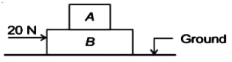
- 7Blocks shown in figure moves with constant velocity $10 \,m / s$ towards right. All surfaces in contact are rough. The friction force applied by $B$ on $A$ is ...........$N$View Solution
- 8On the horizontal surface of a truck a block of mass $1 \;kg$ is placed $(\mu=0.6)$ and truck is moving with acceleration $5\; m / sec ^2$ then the frictional force on the block will beView Solution
- 9A heavy box of mass $50 \mathrm{~kg}$ is moving on a horizontal surface. If co-efficient of kinetic friction between the box and horizontal surface is $0.3$ then force of kinetic friction is :View Solution
- 10A block of mass $M = 5\,kg$ is resting on a rough horizontal surface for which the coefficient of friction is $0.2$. When a force $F = 40\,\,N$ is applied, the acceleration of the block will be ........ $m/\sec^2$ $(g = 10\,\,m/{\sec^2})$View Solution