Question
(i) What is escape velocity? Prove that the velocity required to escape from earth's gravity is 11.2 km/s. Find the value of escape velocity for the moon.
(ii) Calculate the value of escape velocity required to make an object situated at a height h above the earth's surface
Answer

self

Need a full question paper?

Generate a complete, print-ready paper with questions like this in minutes — across 16+ boards, with answer keys.

Start Generating Free

Similar questions

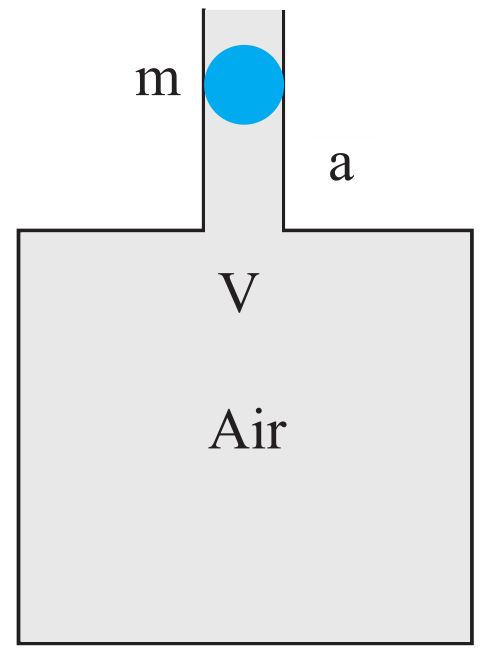
An air chamber of volume V has a neck area of cross section a into which a ball of mass m just fits and can move up and down without any friction (Fig.). Show that when the ball is pressed down a little and released , it executes SHM. Obtain an expression for the time period of oscillations assuming pressure-volume variations of air to be isothermal [see Fig.].
Show that for an isolated system the centre of mass moves with a uniform velocity along a straight line path.
Find the velocity of source, when the frequency appears to be (a) double (b) half, the original frequency to a stationary listener.
Prove the following:
  1. For two angles of projection $\theta$ and $(90-\theta)$ with same velocity v,
  1. Range is same.
  2. Heights are in the ratio $\tan^2: 1$.
  1. If the range and maximum height are equal, the angle of projection is $\tan^{-1}(4)$.
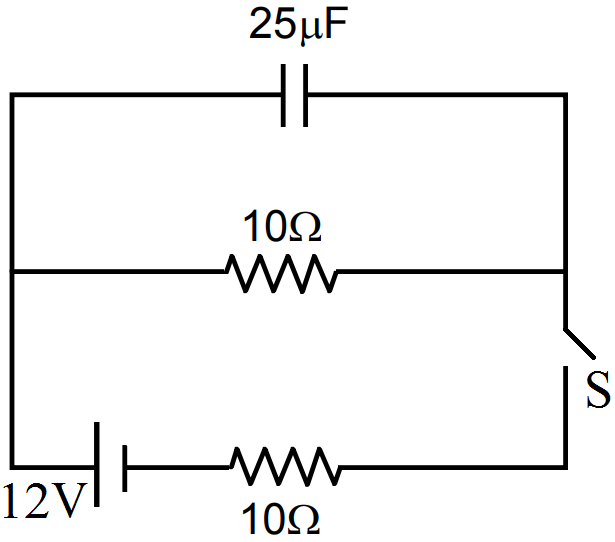
The switch S shown in figure. is kept closed for a long time and is then opened at t = 0. Find the current in the middle $1.0\Omega$ resistor at t = 1ms.
Ten one-rupee coins are put on top of each other on a table. Each coin has a mass m. Give the magnitude and direction of:
  1. The force on the $7^{th}$ coin (counted from the bottom) due to all the coins on its top.
  2. The force on the $7^{th}$ coin by the eighth coin.
  3. The reaction of the 6th coin on the $7^{th}$ coin.
According to Stefan’s law of radiation, a black body radiates energy $\sigma=\text{T}^4$ from its unit surface area every second where T is the surface temperature of the black body and $\sigma=5.67\times10^{-8}\text{w}/\text{m}^2\text{K}^4$ is known as Stefan’s constant. A nuclear weapon may be thought of as a ball of radius $0.5m$. When detonated, it reaches temperature of 106K and can be treated as a black body.
  1. Estimate the power it radiates.
  2. If surrounding has water at $30C°$, how much water can $10\%$ of the energy produced evaporate in $1s$?
$\big[\text{s}_w=4186.0\text{J/ kgK and L}_v=22.6\times10^5\text{J/ kg}\big]$
  1. If all this energy U is in the form of radiation, corresponding momentum is $\rho=\frac{\text{U}}{\text{c}}$ How much momentum per unit time does it impart on unit area at a distance of 1km?
A girl riding a bicycle along a straight road with a speed of $5m s^{–1}$ throws a stone of mass $0.5kg$ which has a speed of $15m s^{–1}$ with respect to the ground along her direction of motion. The mass of the girl and bicycle is $50kg$. Does the speed of the bicycle change after the stone is thrown? What is the change in speed, if so?
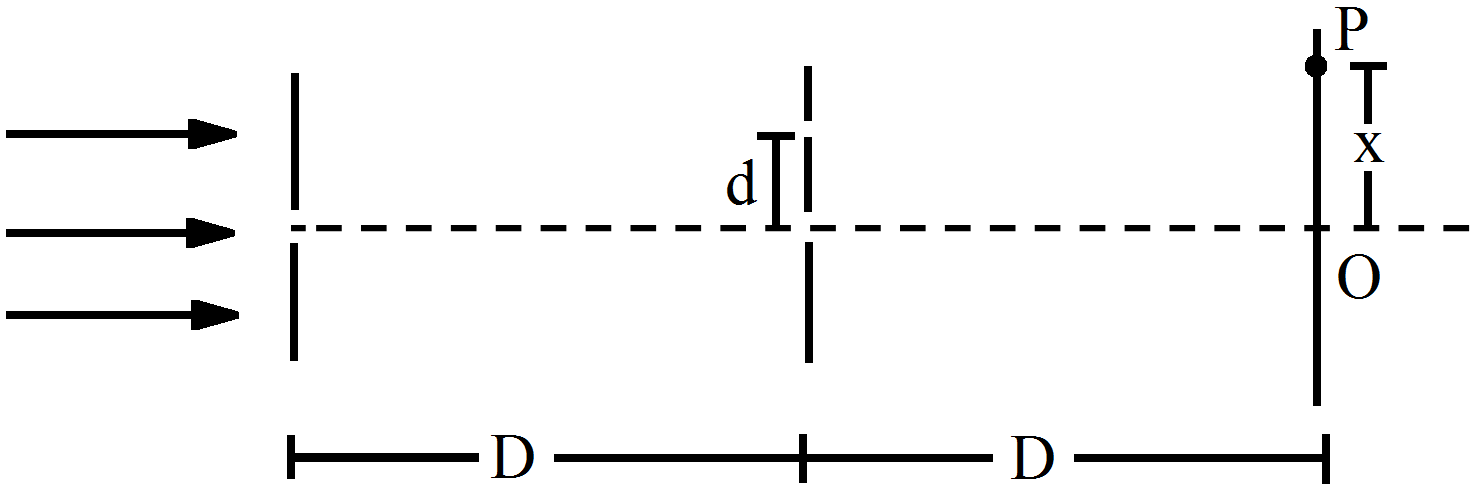
Consider the arrangement shown in figure (17-E4). The distance D is large compared to the separation d between the slits.
  1. Find the minimum value of d so that there is a dark fringe at 0.
  2. Suppose d has this value. Find the distance x at which the next bright fringe is formed.
  3. Find the fringe-width.
Explain elasticity of behaviour.