MCQ
For the myopic eye, the defect is cured by
  • A
    Convex lens
  • Concave lens
  • C
    Cylindrical lens
  • D
    Toric lens

Answer

Correct option: B.
Concave lens
b
(b) In myopia, $u = \infty ,$ $v = d = $ distance of far point

By $ = \frac{{1}}{{f}} =  \frac{{1}}{{v}} -  \frac{{1}}{{u}},$ we get $f = - \;d$

Since $f$ is negative, hence the lens used is concave.

Need a full question paper?

Generate a complete, print-ready paper with questions like this in minutes — across 16+ boards, with answer keys.
Start Generating Free

Similar questions

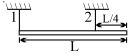
A uniform rod of length $L$ and weight $W$ is suspended horizontally by two vertical ropes as shown. The first rope is attached to the left end of the rod while the second rope is attached a distance $L /4$ from the right end. The tension in the second rope is 
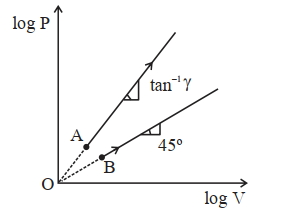
Two thermodynamical process are shown in the figure. The molar heat capacity for process $A$ and $B$ are $C_A$ and $C_B$. The molar heat capacity at constant pressure and constant volume are represented by $C_P$ and $C_V$, respectively. Choose the correct statement.
Which particles will have minimum frequency of revolution when projected with the same velocity perpendicular to a magnetic field
Three capacitors of capacitance $3\,\mu \,F,\,10\,\mu \,F\,$ and $15\,\mu \,F\,$ are connected in series to a voltage source of $100\,V$. The charge on $15\,\mu \,F\,$is.......$\mu C$
The colour of a star is an indication of its
A ball is thrown vertically upwards. Which of the following plots represents the speed-time graph of the ball during its height if the air resistance is not ignored
The intensity of the light from a bulb incident on a surface is $0.22 \,W / m ^{2}$. The amplitude of the magnetic field in this light-wave is_______ $\times 10^{-9} \,T$. (Given : Permittivity of vacuum $\epsilon_{0}=8.85 \times 10^{-12} \,C ^{2} N ^{-1} m ^{-2}$, speed of light in vacuum $c =3 \times 10^{8} \,ms ^{-1}$ )
$\pi $ mesons can be
A shell of mass $m$ is at rest initially. It explodes into three fragments having mass in the ratio $2: 2: 1$. If the fragments having equal mass fly off along mutually perpendicular directions with speed $v$, the speed of the third (lighter) fragment is :
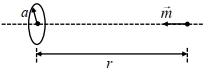
A special metal $S$ conducts electricity without any resistance. A closed wire loop, made of $S$, does not allow any change in flux through itself by inducing a suitable current to generate a compensating flux. The induced current in the loop cannot decay due to its zero resistance. This current gives rise to a magnetic moment which in turn repels the source of magnetic field or flux. Consider such a loop, of radius $a$, with its center at the origin. A magnetic dipole of moment $m$ is brought along the axis of this loop from infinity to a point at distance $r \gg a)$ from the center of the loop with its north pole always facing the loop, as shown in the figure below.

The magnitude of magnetic field of a dipole $m$, at a point on its axis at distance $r$, is $\frac{\mu_0}{2 \pi} \frac{m}{r^3}$, where $\mu_0$ is the permeability of free space. The magnitude of the force between two magnetic dipoles with moments, $m_1$ and $m_2$, separated by a distance $r$ on the common axis, with their north poles facing each other, is $\frac{k m_1 m_2}{r^4}$, where $k$ is a constant of appropriate dimensions. The direction of this force is along the line joining the two dipoles.

($1$) When the dipole $m$ is placed at a distance $r$ from the center of the loop (as shown in the figure), the current induced in the loop will be proportional to

$(A)$ $\frac{m}{r^3}$ $(B)$ $\frac{m^2}{r^2}$ $(C)$ $\frac{m}{r^2}$ $(D)$ $\frac{m^2}{r}$

($2$) The work done in bringing the dipole from infinity to a distance $r$ from the center of the loop by the given process is proportional to

$(A)$ $\frac{m}{r^5}$ $(B)$ $\frac{m^2}{r^5}$ $(C)$ $\frac{m^2}{r^6}$ $(D)$ $\frac{m^2}{r^7}$

Give the answer or qution ($1$) and ($2$)