A special metal $S$ conducts electricity without any resistance. A closed wire loop, made of $S$, does not allow any change in flux through itself by inducing a suitable current to generate a compensating flux. The induced current in the loop cannot decay due to its zero resistance. This current gives rise to a magnetic moment which in turn repels the source of magnetic field or flux. Consider such a loop, of radius $a$, with its center at the origin. A magnetic dipole of moment $m$ is brought along the axis of this loop from infinity to a point at distance $r \gg a)$ from the center of the loop with its north pole always facing the loop, as shown in the figure below.
The magnitude of magnetic field of a dipole $m$, at a point on its axis at distance $r$, is $\frac{\mu_0}{2 \pi} \frac{m}{r^3}$, where $\mu_0$ is the permeability of free space. The magnitude of the force between two magnetic dipoles with moments, $m_1$ and $m_2$, separated by a distance $r$ on the common axis, with their north poles facing each other, is $\frac{k m_1 m_2}{r^4}$, where $k$ is a constant of appropriate dimensions. The direction of this force is along the line joining the two dipoles.
($1$) When the dipole $m$ is placed at a distance $r$ from the center of the loop (as shown in the figure), the current induced in the loop will be proportional to
$(A)$ $\frac{m}{r^3}$ $(B)$ $\frac{m^2}{r^2}$ $(C)$ $\frac{m}{r^2}$ $(D)$ $\frac{m^2}{r}$
($2$) The work done in bringing the dipole from infinity to a distance $r$ from the center of the loop by the given process is proportional to
$(A)$ $\frac{m}{r^5}$ $(B)$ $\frac{m^2}{r^5}$ $(C)$ $\frac{m^2}{r^6}$ $(D)$ $\frac{m^2}{r^7}$
Give the answer or qution ($1$) and ($2$)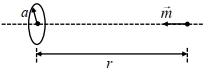
IIT 2021, Advanced


Download our appand get started for free
Experience the future of education. Simply download our apps or reach out to us for more information. Let's shape the future of learning together!No signup needed.*
Similar Questions
- 1A galvanometer of resistance $100 \Omega$ when connected in series with $400 \Omega$ measures a voltage of upto $10 \mathrm{~V}$. The value of resistance required to convert the galvanometer into ammeter to read upto $10 \mathrm{~A}$ is $\mathrm{x} \times 10^{-2} \Omega$. The value of $\mathrm{x}$ is :View Solution
- 2A charge of $4.0 \mu \mathrm{C}$ is moving with a velocity of $4.0 \times 10^6 \mathrm{~ms}^{-1}$ along the positive $\mathrm{y}$-axis under a magnetic field $\vec{B}$ of strength $(2 \hat{k})\ T$. The force acting on the charge is $x \hat{i} N$. The value of $x$ is__________.View Solution
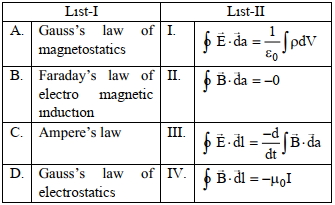
- 3Match List $I$ with List $II$View Solution
Choose the correct answer from the options given below:
- 4If number of turns, area and current through a coil is given by $N, A$ and $I$ respectively then its magnetic moment will beView Solution
- 5An ion beam of specific charge $5 \times 10^7$ $coulomb/kg$ enter a uniform magnetic field of $4 \times 10^{-2}\, tesla$ with a velocity $2 \times 10^5\, m/s$ perpendicularly. The radius of the circular path of ions in meter will beView Solution
- 6The magnetic field existing in a region is given by $\vec{B}=B_0\left(1+\frac{x}{l}\right) \hat{k}$. A square loop of edge I and carrying a current $i$, is placed with its edge parallel to the $x-y$ axes. Find the magnitude of the net magnetic force experienced by the loopView Solution
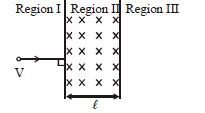
- 7A particle of mass $m$ and charge $q$ , moving with velocity $V$ enters region $II$ normal to the boundary as shown in the figure. Region $II$ has a uniform magnetic field $B$ perpendicular to the plane of the paper. The length of the region $II$ is $l$ . Choose the not correct choiceView Solution
- 8If only $2\,%$ of the main current is to be passed through a galvanometer of resistance $G$, then the resistance of shunt will beView Solution
- 9If an electron revolves around a nucleus in a circular orbit of radius $R$ with frequency $n$, then the magnetic field produced at the centre of the nucleus will beView Solution
- 10A long straight wire carries a current of $35\; A$. What is the magnitude of the field $B$ at a point $20\; cm$ from the wire?View Solution