Three capacitors of capacitance $3\,\mu \,F,\,10\,\mu \,F\,$ and $15\,\mu \,F\,$ are connected in series to a voltage source of $100\,V$. The charge on $15\,\mu \,F\,$is.......$\mu C$
AIIMS 2000, Medium
Download our app for free and get started
(c) $\frac{1}{{{C_{eq}}}} = \frac{1}{3} + \frac{1}{{10}} + \frac{1}{{15}} \Rightarrow {C_{eq}} = 2\,\mu F$
Charge on each capacitor
$Q = C_{eq} × V \Rightarrow 2 \times 100 = 200\,\mu C$
Charge on each capacitor
$Q = C_{eq} × V \Rightarrow 2 \times 100 = 200\,\mu C$

Download our appand get started for free
Experience the future of education. Simply download our apps or reach out to us for more information. Let's shape the future of learning together!No signup needed.*
Similar Questions
- 1View SolutionAssertion : Two concentric charged shells are given. The potential difference between the shells depends on charge of inner shell.
Reason : Potential due to charge of outer shell remains same at every point inside the sphere.

- 2For changing the capacitance of a given parallel plate capacitor, a dielectric material of dielectric constant $K$ is used, which has the same area as the plates of the capacitor. The thickness of the dielectric slab is $\frac{3}{4} d$, where $'d'$ is the separation between the plates of parallel plate capacitor. The new capacitance $(C')$ in terms of original capacitance $\left( C _{0}\right)$ is given by the following relationView Solution
- 3There are four concentric shells $A, B, C $ and $D $ of radii $ a, 2a, 3a$ and $4a$ respectively. Shells $B$ and $D$ are given charges $+q$ and $-q$ respectively. Shell $C$ is now earthed. The potential difference $V_A - V_C $ is :View Solution
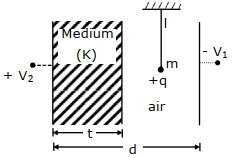
- 4A simple pendulum of mass $'m',$ length $'I'$ and charge $'+q'$ suspended in the electric field produced by two conducting parallel plates as shown. The value of deflection of pendulum in equilibrium position will be -View Solution
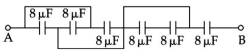
- 5The equivalent capacitance between points $A$ and $B$ in below shown figure will be..........$\mu F$.View Solution
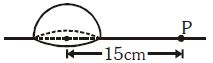
- 6Figure shows a solid hemisphere with a charge of $5\ nC$ distributed uniformly through its volume. The hemisphere lies on a plane and point $P$ is located on this plane, along a radial line from the centre of curvature at distance $15\ cm$. The electric potential at point $P$ due to the hemisphere, is .....$V$View Solution
- 7View SolutionA capacitor is charged by a battery. The battery is removed and another identical uncharged capacitor is connected in parallel. The total electrostatic energy of resulting system
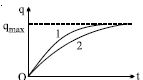
- 8The charge across the capacitor in two different $RC$ circuits $1$ and $2$ are plotted as shown in figure. Choose the correct statement $(s)$ related to the two circuits.View Solution
- 9The electric potential varies in space according to the relation $V = 3x + 4y$. A particle of mass $0.1\,\, kg$ starts from rest from point $(2, 3·2)$ under the influence of this field. The charge on the particle is $+1\,\, μC$. Assume $V$ and $(x, y)$ are in $S.I.$ $units$ . The time taken to cross the $x-$ axis is.....$s$View Solution
- 10The energy of a charged capacitor is given by the expression ($q$= charge on the conductor and $C$ = its capacity)View Solution