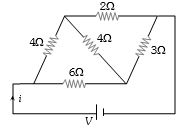
For the network shown in the figure the value of the current $i$ is
AIPMT 2005, Medium
Download our app for free and get started
The given network is a balanced Wheatstone bridge. It's equivalent resistance will be $R = \frac{{18}}{5}\,\Omega $
So current from the battery $i = \frac{V}{R} = \frac{V}{{18/5}} = \frac{{5V}}{{18}}$

Download our appand get started for free
Experience the future of education. Simply download our apps or reach out to us for more information. Let's shape the future of learning together!No signup needed.*
Similar Questions
- 1An electric bulb rated $50 \mathrm{~W}-200 \mathrm{~V}$ is connected across a $100 \mathrm{~V}$ supply. The power dissipation of the bulb is :View Solution
- 2A copper wire has a square cross-section, $2.0\, mm$ on a side. It carries a current of $8\, A$ and the density of free electrons is $8 \times {10^{28}}\,{m^{ - 3}}$. The drift speed of electrons is equal toView Solution
- 3Two conductors have the same resistances at $0^{\circ} \mathrm{C}$ but their temperature coefficients of resistance are $\alpha_1$ and $\alpha_2$. The respective temperature coefficients for their series and parallel combinations are :View Solution
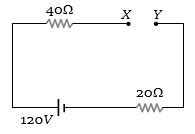
- 4Potential difference across the $40\,\Omega $ resistance will be ............ $V$View Solution
- 5For which of the following dependence of drift velocity $v$ on electric field $E$ is ohm's law obeyedView Solution
- 6A bulb of $100\, W$ is connected in parallel with an ideal inductance of $1\, H$. This arrangement is connected to a $90\,V$ battery through a switch. On pressing the switch, theView Solution
- 7When a resistance of $2\, ohm$ is connected across the terminals of a cell, the current is $0.5\, A$. When the resistance is increased to $5\, ohm$, the current is $0.25\, A$. The $e.m.f.$ of the cell is ................. $V$View Solution
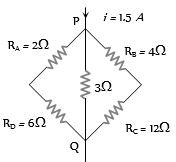
- 8Potential difference between the points $P$ and $Q$ in the electric circuit shown is ................. $V$View Solution
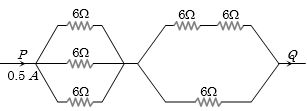
- 9Resistances of $6\, ohm$ each are connected in the manner shown in adjoining figure. With the current $0.5\,ampere$ as shown in figure, the potential difference ${V_P} - {V_Q}$ is .............. $V$View Solution
- 10A potentiometer has uniform potential gradient. The specific resistance of the material of the potentiometer wire is $10^{-7} \, ohm-meter$ and the current passing through it is $0.1\, ampere$; cross-section of the wire is $10^{-6}\, m^2$. The potential gradient along the potentiometer wire isView Solution