MCQ
For the one$-$dimensional motion, described by $\text{x}=\text{t}-\sin\text{t}.$
  • A
    $x (t) > 0$ for all $t > 0.$
  • B
    $v (t) > 0$ for all $t > 0.$
  • C
    $v (t)$ lies between $0$ and $3.$
  • $A$ and $C$

Answer

Correct option: D.
$A$ and $C$
Position of the particle is given as a function of time
i.e. $\text{x}=\text{t}-\sin\text{t}$ By differentiating this equation w.r.t. time we get velocity of the particle as a function of time.
Velocity $\text{v}=\frac{\text{dx}}{\text{dt}}=\frac{\text{d}}{\text{dt}}[\text{t}-\sin\text{t}]=1-\cos\text{t}$
If we again differentiate this equation w,r,t, time we will get will get acceleration of the particle as a function of time.
Acceleration $\text{a}=\frac{\text{dv}}{\text{dt}}=\frac{\text{d}}{\text{dt}}[1-\cos\text{t}]=\sin\text{t}$
As acceleration $a > 0$ for all $t > 0$
Hence, $x(t) > 0$ for all $t > 0$
Velocity $\text{v}=1-\cos\text{t}$
When, $\cos\text{t}-1,$ velocity $v = 0$
$\text{v}_\text{max}=1-(\cos\text{t})_\text{min}=1-(-1)=2$
$\text{v}_\text{min}=1-(\cos\text{t})_\text{max}=1-1=0$
Hence, $v$ lies between $0$ and $2.$
Acceleration $\text{a}=\frac{\text{dv}}{\text{dt}}=-\sin\text{t}$
When $t = 0; x = 0, v = 0, a = 0$
When $\text{t}=\frac{\pi}{2}; x =$ positive, $v = 0, a = -1 ($negative$)$
When $\text{t}=2\pi,\text{x}=0,\text{v}=0,\text{a}=0$

Need a full question paper?

Generate a complete, print-ready paper with questions like this in minutes — across 16+ boards, with answer keys.

Start Generating Free

Similar questions

A solid ball is completely immersed in a liquid. The coefficients of volume expansion of the ball and liquid are $3 × 10^{-6}$ and $8 × 10^{-6} per ^o C$ respectively. The percentage change in upthrust when the temperature is increased by $100 ^o C$ is ....... $\%$
If a long spring is stretched by $0.02\, m$, its potential energy is $U$. If the spring is stretched by $0.1\, m$ then its potential energy will be
When a body of mass $1.0\, kg$ is suspended from a certain light spring hanging vertically, its length increases by $5\, cm$. By suspending $2.0\, kg$ block to the spring and if the block is pulled through $10\, cm$ and released the maximum velocity in it in $m/s$ is : (Acceleration due to gravity $ = 10\,m/{s^2})$
A tube of length $L$ is filled completely with an incompressible liquid of mass $M$ and closed at both the ends. The tube is then rotated in a horizontal plane about one of its ends with a uniform angular velocity $\omega $. The force exerted by the liquid at the other end is
The initial velocity of a body moving along a straight line is $7 \,m/s$. It has a uniform acceleration of $4\,m/{s^2}$. The distance covered by the body in the $5^{th}$ second of its motion is..........$m$
Ionization energy of a hydrogen$-$like ion $A$ is greater than that of another hydrogen$-$like ion $B$. Let $r, u, E$ and $L$ represent the radius of the orbit, speed of the electron, energy of the atom and orbital angular momentum of the electron respectively. In ground state:
A tuning fork of frequency $392 Hz,$ resonates with $50 cm $ length of a string under tension ($T$). If length of the string is decreased by $2\%$, keeping the tension constant, the number of beats heard when the string and the tuning fork made to vibrate simultaneously is
The Bhagirathi and the Alaknanda merge at Deoprayag to form the Ganga with their speeds in the ratio $1: 1: 5$. The cross-sectional areas of the Bhagirathi, the Alaknanda and the Ganga are in the ratio $1: 2: 3$. Assuming streamline flow, the ratio of the speed of Ganga to that of the Alaknanda is
Students $I$, $II$ and $III$ perform an experiment for measuring the acceleration due to gravity $(g)$ using a simple pendulum.

They use different lengths of the pendulum and /or record time for different number of oscillations. The observations are shown in the table.

Least count for length $=0.1 \mathrm{~cm}$

Least count for time $=0.1 \mathrm{~s}$

Student Length of the pendulum $(cm)$ Number of oscillations $(n)$ Total time for $(n)$ oscillations $(s)$ Time period $(s)$
$I.$ $64.0$ $8$ $128.0$ $16.0$
$II.$ $64.0$ $4$ $64.0$ $16.0$
$III.$ $20.0$ $4$ $36.0$ $9.0$

If $\mathrm{E}_{\mathrm{I}}, \mathrm{E}_{\text {II }}$ and $\mathrm{E}_{\text {III }}$ are the percentage errors in g, i.e., $\left(\frac{\Delta \mathrm{g}}{\mathrm{g}} \times 100\right)$ for students $\mathrm{I}, \mathrm{II}$ and III, respectively,
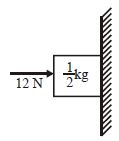
A horizontal force $12 \,N$ pushes a block weighing $1/2\, kg$ against a vertical wall.  The  coefficient of static friction between the wall and the block is $0.5$ and the coefficient of  kinetic friction is $0.35.$ Assuming that the block is not moving  initially. Which one of the following choices is correct (Take $g = 10 \,m/s^2$)